Fast Stream Assessment Centre (FSAC): Exercises, 4D Framework and How to Prepare


The Fast Stream Assessment Centre, known as FSAC, is the stage after the online tests where the Civil Service decides who goes forward to the Final Selection Board. This guide sets out what the official guide says about the three exercises, the 4D framework and how to prepare, and flags where older advice no longer matches.
One honest limit up front: the official pages we could open do not publish a timing for each exercise, apart from the 30-minute conversation, so we mark those as “Not published”. Anything marked “Official” comes from the Civil Service Fast Stream Assessment Centre guide. For dates and the scheme itself, see our Civil Service Fast Stream 2027 guide.
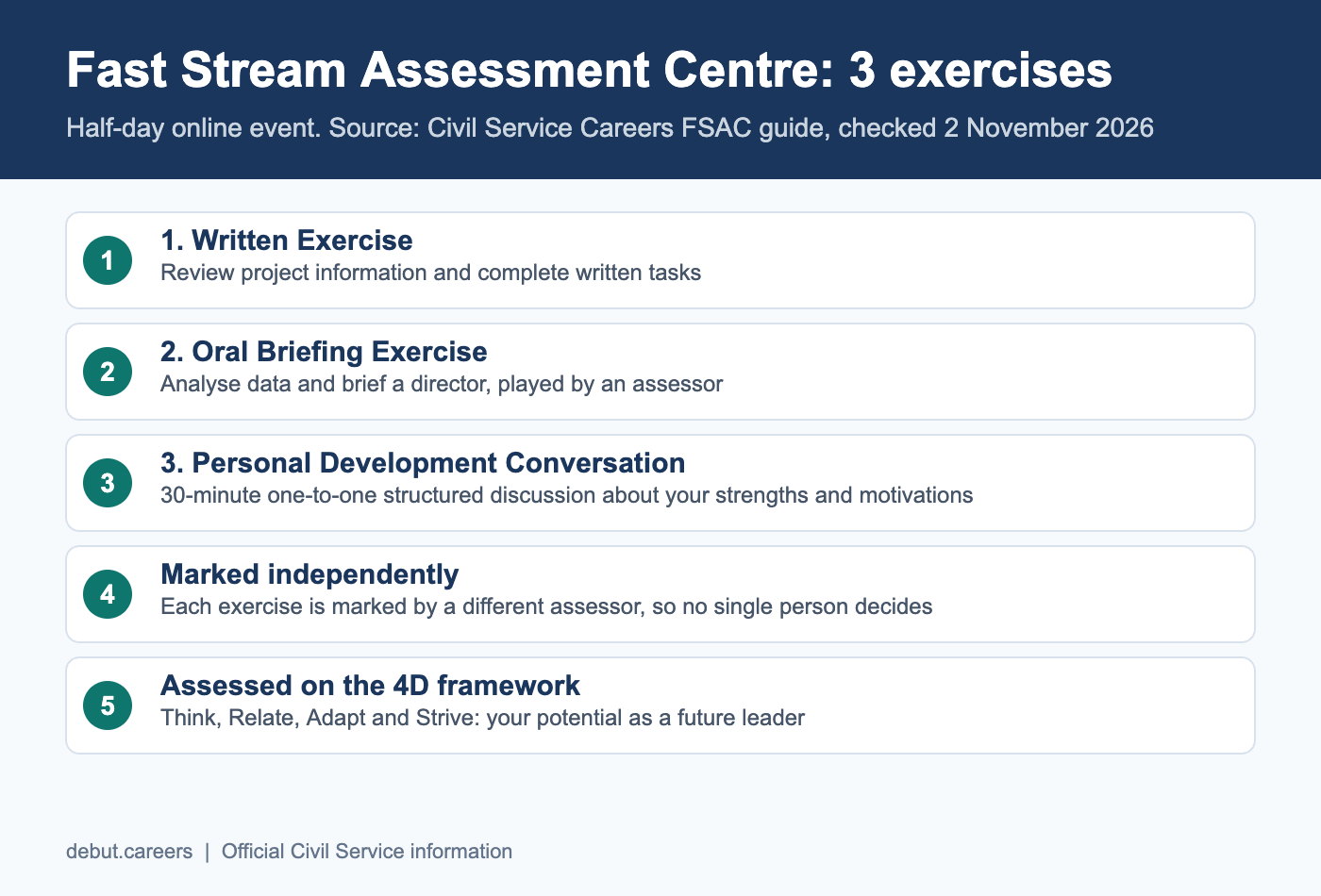
Fast Stream Assessment Centre at a glance
| Item | What we found | Evidence |
|---|---|---|
| Format | Half-day online event | Official |
| Exercises | Written Exercise, Oral Briefing Exercise, Personal Development Conversation | Official |
| Marking | Each exercise is marked independently by a different assessor; no single person makes the final decision | Official |
| Framework | 4D: Think, Relate, Adapt, Strive | Official |
| Assessors | A team of civil servants and assessment specialists; they do not see your application or previous scores | Official |
| Written Exercise | Review project information and complete written tasks | Official |
| Oral Briefing Exercise | Analyse data and brief a director, who is portrayed by an assessor | Official |
| Personal Development Conversation | 30-minute one-to-one structured discussion with an assessor | Official |
| Timing of the written and oral exercises | Not stated on the pages we could open | Not published |
| Next stage | Final Selection Board, listed in the Fast Stream how-to-apply menu | Official |
Source for the Official rows: the FSAC guide and its pages on what is assessed, the assessments and the personal development conversation, checked on 2 November 2026.
The 4D framework: what is assessed
The Civil Service says it uses the 4D (4 Dimensions) Assessment Framework to assess your potential, and that it is not looking for perfection but for potential as a future leader.
- Think: how you gather, process and analyse information, think critically and make decisions while keeping the bigger picture in mind.
- Relate: your interpersonal skills and emotional intelligence, including how you engage with others and contribute to teamwork.
- Adapt: your flexibility and learning agility, including how you handle change and absorb new information.
- Strive: your drive and values, including motivation, resilience and commitment to ethical behaviour.
Prep self-check
0 of 5 done
The three exercises
Written Exercise
You review project information and complete written tasks. The Civil Service links to an example of this exercise from its guide. Practise reading quickly, picking out what matters and writing clearly under time pressure.
Oral Briefing Exercise
You analyse data and brief a director, portrayed by an assessor, on your findings. Practise summarising numbers into a short spoken message. Our numerical reasoning guide helps with the data side.
Personal Development Conversation
A 30-minute one-to-one structured discussion with an assessor. It includes forward-looking questions about your talents, behavioural questions about past situations, examples from volunteering, work, education or hobbies, and self-reflection on your strengths and development areas. The Civil Service says you do not need to memorise answers and that the best preparation is self-reflection. It assesses Relate, Adapt and Strive.
The exercises may share a common theme, but they are separate tasks and each is marked on its own by a different assessor, so a weaker exercise does not sink the others.
How to prepare
- Learn the 4D framework and note one example for each dimension.
- Do the reflection the Civil Service recommends: identify strengths, know your motivators, reflect on growth and understand your “Fast Stream fit”.
- Read all instructions carefully and ask before an exercise if unsure; keep an eye on the clock because the tasks require you to work quickly.
- Remember you are assessed against a set standard, not against other candidates.
- Use examples from hobbies, volunteering or home life as well as work and study.
- Practise out loud with a friend, then use our assessment centre guide and situational judgement test guide for general habits.
“Stay calm at the FSAC”
Hayat, Fast Streamer, in a 2017 Bright Network interview — Bright Network
That is one person’s tip from 2017, when she described a group exercise at the assessment centre, so treat it as general advice about staying calm rather than as a description of today’s format.
Why older advice can mislead you
Many prep sites and older accounts describe a group exercise, a leadership exercise or a full day. The current official guide lists three exercises and a half-day online event, and the Civil Service says the exercises are marked independently. If a source mentions exercises that are not in the official guide, check its date before you rely on it.
How FSAC compares with other assessment centres
Private-sector graduate schemes usually mix group, presentation and interview tasks, as in PwC’s and Deloitte’s assessment centres. The Fast Stream version is shorter and built around three separate exercises and the 4D framework. Weighing the scheme itself against other options? Read Fast Stream vs PwC and Fast Stream vs NHS.
Frequently asked questions
How long is the Fast Stream Assessment Centre?
The Civil Service says the Fast Stream Assessment Centre (FSAC) is a half-day online event.
What exercises are in the Fast Stream Assessment Centre?
Three: a Written Exercise, an Oral Briefing Exercise and a Personal Development Conversation. They may share a common theme but are separate tasks, each marked independently by a different assessor.
Is there a group exercise at the Fast Stream Assessment Centre?
The current official FSAC guide lists three exercises and a group exercise is not one of them. Older accounts, such as a 2017 interview with a Fast Streamer, describe a group exercise, so be careful with older advice.
What are the 4D dimensions?
The 4D Assessment Framework has four dimensions: Think (how you gather, process and analyse information), Relate (interpersonal skills and emotional intelligence), Adapt (flexibility and learning agility) and Strive (drive, resilience and values).
Do assessors see my application?
No. The Civil Service says assessors have limited information about you: they do not see your application form or previous scores and do not know your educational or employment history.
What happens after the assessment centre?
The Fast Stream how-to-apply menu lists the stages as initial application, online tests, Assessment Centre and Final Selection Board. Check the official guide for what happens after your FSAC.