Situational Judgement Test (SJT): How It Works and How to Pass


Updated Test formats differ by employer. Always follow the instructions in your own invitation.
29 October 2026
A situational judgement test (SJT) drops you into a realistic workplace scenario and asks what you would do. There is rarely a single obviously right answer, which is why many graduates find it harder to prepare for than a numerical or verbal test. This guide explains how SJTs work, what the official Civil Service version looks like, and how to answer in a way that fits the employer.
What is a situational judgement test?
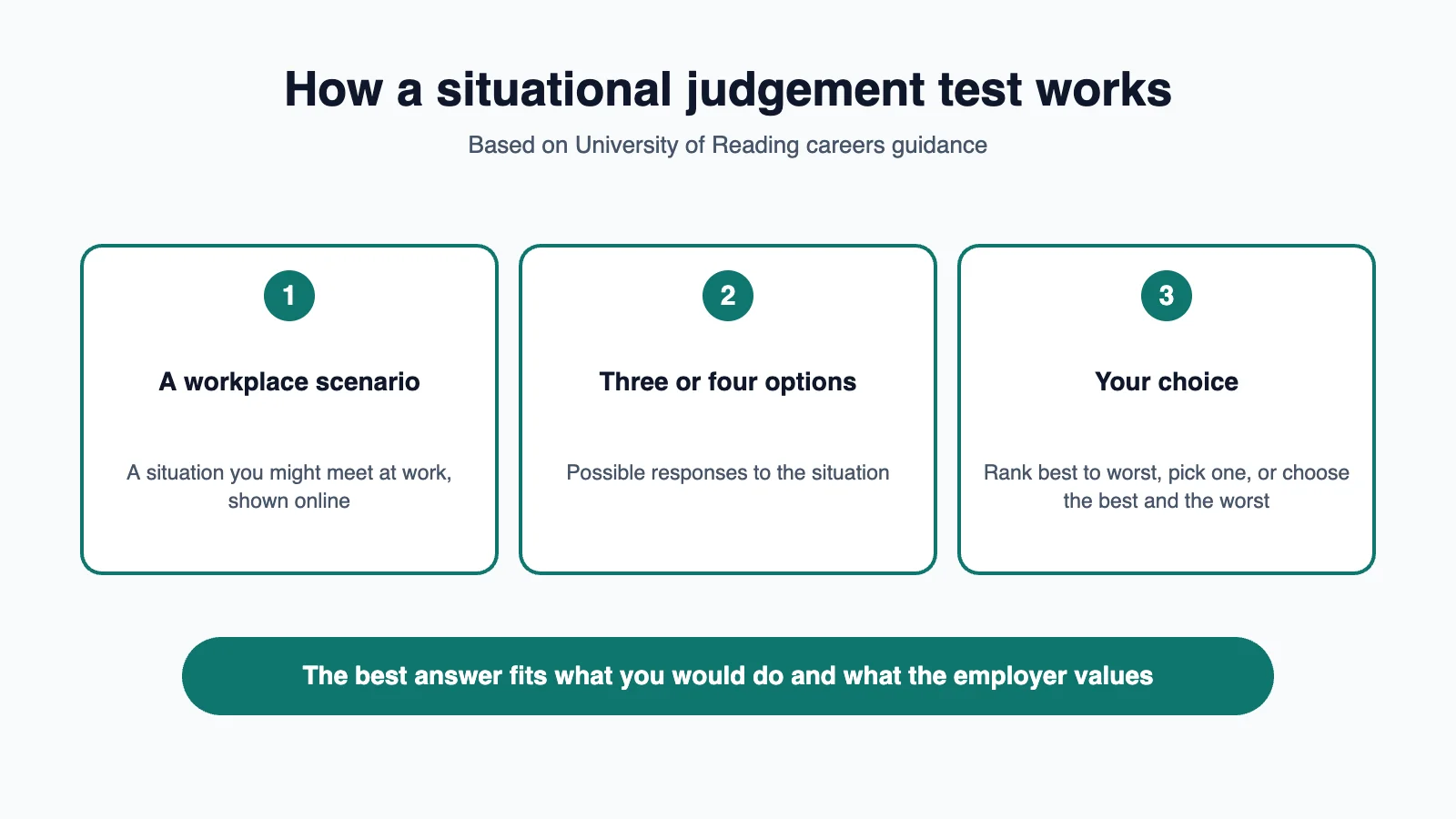
SJTs are online tests that simulate situations you might meet at work. As the University of Reading careers team explains, the system usually gives you three or four options and you may have to rank them from best to worst, pick the one you would do, or choose the best and the worst. Often several options are acceptable in the abstract; the “right” one is the one that fits how that organisation works.
How the Civil Service Judgement Test works
The clearest official description is GOV.UK’s guidance on the Civil Service Judgement Test (CSJT), which is used for Civil Service roles including the Fast Stream. It is an online SJT that measures judgement and decision-making against the Civil Service Behaviours chosen for the job.
| Feature | What GOV.UK says |
|---|---|
| Part 1 | Self-assessment of your typical behaviour and preferences at work; worth 15% of the CSJT score. Answer honestly, as you may be asked about it at interview. |
| Part 2 | Workplace scenarios, each with four possible actions. You rate every action on a four-point scale. |
| Rating scale | Counterproductive, Ineffective, Fairly Effective, Effective. You can give more than one action the same rating. |
| Scenarios | Three scenarios per behaviour, four actions each. Some behaviours use short videos, others text; you may see only video, only text, or a mix. |
| Timing | Not timed. Most people take two to four minutes per scenario; allow at least an hour. |
| Results | Shown as a percentile against other applicants. Recruiters set the pass mark and may raise it. |
| Retakes | If you do not meet the standard you can retake it in future applications. You may be asked to retake it under supervised conditions if invited to interview. |
GOV.UK also provides an unscored practice test so you can see the look and feel before the real thing, and advises taking the test early so you can fix technical problems before the deadline.
SJT formats you will meet
| Format | What you do | Where you may see it |
|---|---|---|
| Rate each action | Score every option for effectiveness | Civil Service Judgement Test (official) |
| Best and worst | Choose the most and least effective action | Many graduate employer tests (reported) |
| Rank all options | Order the actions from best to worst | Many graduate employer tests (reported) |
| Choose what you would do | Pick the single action you would take | Some employers (reported) |
Formats vary from paper-based to computer-based, sometimes with video or animation, and a typical test lasts around 30 minutes according to the LSE careers service. The CSJT is the exception: it is untimed.
Which graduate employers use SJTs
LSE’s careers service lists employers that use SJTs, including the Civil Service Fast Stream, John Lewis, Sony, Network Rail and the NHS Graduate Management Training Scheme, alongside several Big Four and law firms. Third-party guides report that the NHS scheme’s online assessment includes an SJT, but the format and timing are not published in the sources we could verify, so check your invitation. On Debut, see how SJTs appear in our guides to the Bank of England, JLR and MI5, MI6 and GCHQ schemes, and the overview of which employers use which online tests.
How to answer: a five-step method
1. Read the scenario twice
Identify who is involved, what the real problem is and what is at stake before you look at the options.
2. Judge each action on its own
On rating-style tests (like the CSJT) do not assume only one action is effective; GOV.UK says you can rate more than one the same.
3. Match the employer’s values
Use the behaviours, values or competencies in the job advert. Escalating, communicating and checking facts usually beat acting alone, but follow the employer’s own culture.
4. Avoid extremes
Actions that ignore the problem, hide it or go over someone’s head without cause tend to score poorly.
5. Stay consistent
Employers can compare your answers across scenarios and against the self-assessment part, so answer honestly rather than strategically.
Practice and preparation
Start with the practice test your employer provides. For general practice, the University of Reading’s post points to free video guides and practice tests, and the Local Government Association’s National Graduate Development Programme publishes its own candidate guidance. Build self-knowledge too: the experiences you draw on in an SJT come from part-time work, society roles and group projects. Our guide to acing psychometric tests covers the wider test stage.
Test-day checklist
FAQ
What is a situational judgement test?
An online test that shows you realistic workplace scenarios and asks you to rate, rank or choose between possible actions. Employers use it to see how your judgement fits the behaviours they value.
Is the Civil Service Judgement Test timed?
No. GOV.UK says it is not timed, but most people take two to four minutes per scenario and it recommends allowing at least an hour.
Can I fail an SJT?
Yes. Your score is compared with other applicants and shown as a percentile, and recruiters set a pass mark. If you miss the minimum for a job level you can retake the test in a future application.
How do I practise for an SJT?
Take the official practice test if your employer provides one, read the employer’s values and competencies, and practise rating actions independently rather than hunting for one right answer.
Do I need to retake the test at interview?
Possibly. For Civil Service roles, hiring managers may ask candidates invited to interview to retake the test under supervised conditions, and you are told if so.
Sources: GOV.UK (Civil Service Judgement Test guidance), University of Reading Careers, LSE Careers, Local Government Association. Format details outside the Civil Service are reported by third-party guides; confirm with each employer.