Can You Use AI in a Graduate Application? What UK Employers Say (2027)

Rolling Rules are set by each employer and change. Always read the guidance in your own application, which overrides anything on this page.
27 October 2026
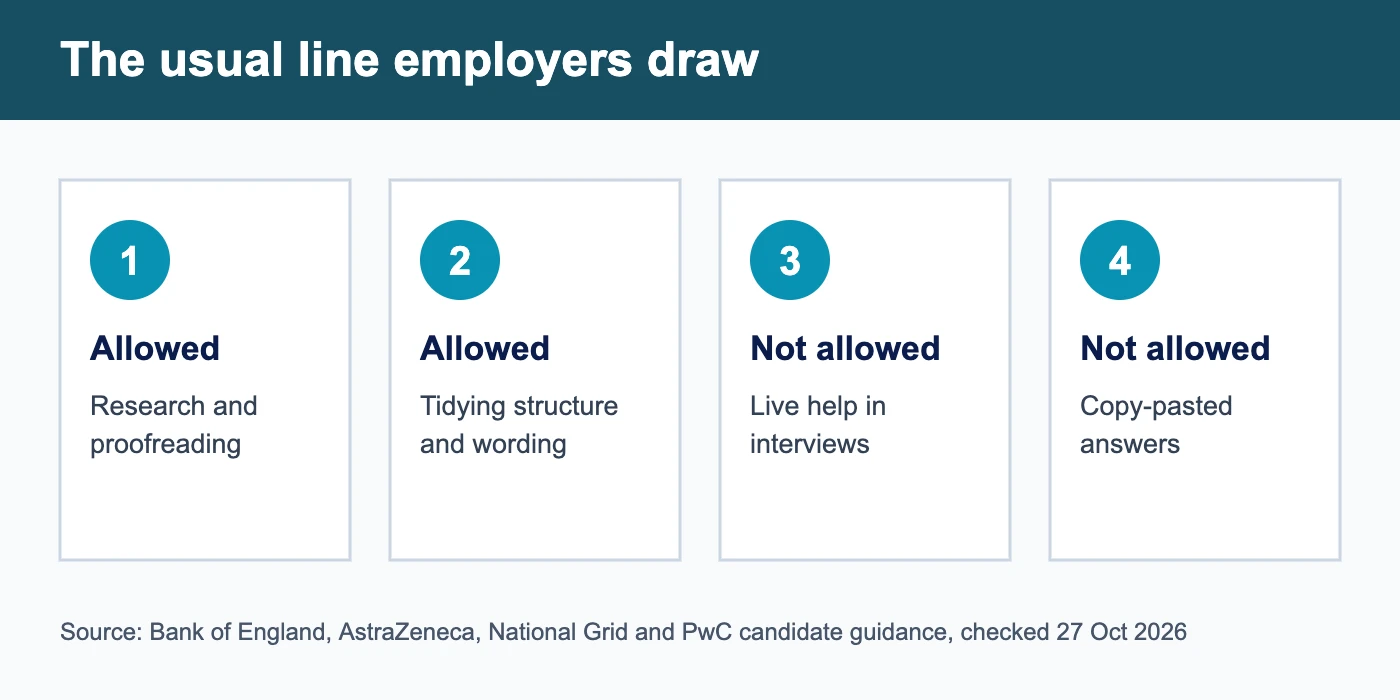
Most UK graduate employers now publish a position on AI, and they are more alike than you might expect: AI to research and polish is usually welcome, AI to write your answers or help you live is not. This guide collects what each employer says in its own words, shows where the rules differ, and gives you a safe way to work. It draws on the official candidate pages of the Bank of England, AstraZeneca, PwC and National Grid, plus the guidance summarised on our own employer pages.
What UK graduate employers say about AI in applications
| Employer | Allowed | Not allowed |
|---|---|---|
| Bank of England | Research, proofreading, refining answers, mock interview practice | Copy-pasting AI answers; any AI tool in video, live interview or group exercise |
| AstraZeneca | Research, refining a CV, practising questions; be open about it if asked | Misrepresenting skills; real-time answers in interviews or assessments; unapproved recording tools |
| PwC | Nothing stated for the application form beyond writing it yourself | AI or third-party help with assessment responses unless PwC authorises it |
| National Grid | Research, preparation, refining a CV if truthful | Relying on AI to write applications; AI in interviews or assessments |
| Rolls-Royce | AI as a foundation or first draft, with your own personality added | Presenting generic AI text as your own interests |
| Arup | Not stated beyond the application | AI writing assistants in the application |
| Sky / BT | Not stated | Sky: AI in online assessments. BT: its pack says text answers are checked for AI-generated content |
Summary of each employer’s published position, checked 27 October 2026. Rows for Rolls-Royce, Arup, Sky and BT come from the guidance summarised on our employer guides; always check the current instructions.
What the official pages actually say
| Bank of England | Eleven numbered points; use AI for research and proofreading, not copy-paste. | Official |
| AstraZeneca | Misuse includes generating real-time answers during interviews or assessments. | Official |
| PwC | AI-assisted support is not permitted in assessments unless explicitly authorised. | Official |
| PwC | PwC does not use AI to assess candidate performance in early careers selection. | Official |
| Unilever | States it does not use AI as a screening tool; a person reviews video interviews. | Reported |
Sources: Bank of England how-to-apply page, AstraZeneca AI guidance, PwC assessment and selection process, checked 27 October 2026. Unilever is as summarised on our Unilever guide.
The one rule every employer repeats: your own words
The Bank of England says it plainly: avoid copying and pasting an AI-generated response, because it is inauthentic and hinders the integrity of your application. It also warns that over-relying on AI can leave you at interview not understanding concepts you mentioned earlier. AstraZeneca asks you to review and personalise AI-supported content so it reflects your own voice. The pattern is consistent: AI can help you think and tidy, but the experience and the wording must be yours.
The second rule: no AI during live stages and assessments
Interviews and assessments are where rules are strictest. The Bank of England bans any AI tool in the video interview, live interview or group exercise. AstraZeneca lists generating real-time answers in interviews or assessments as misuse. PwC says assessments must be completed independently and that AI or third-party help is not permitted unless it authorises it. For a video format, see our video interview guide.
Do employers use AI to judge you?
This is a separate question and the answers vary. PwC states it does not use AI to assess candidate performance in early careers selection, and our Unilever guide records that Unilever says a real person reviews its video interviews. Some employers use automated steps for reasons other than judging answers, such as checking for duplicate accounts or highly similar responses, which PwC says it does. Treat any claim of “AI-proof” as the employer’s statement of its own process, not a guarantee.
A safe way to use AI in an application
Use it for research on the employer, for a grammar and spelling check, and for questions to practise with. Write your first draft yourself from real examples, then ask for structural suggestions if the employer allows it, and rewrite in your own voice. Keep a note of how you used it, because AstraZeneca asks you to be open about it if asked. Do not use it during any recorded or live stage, and if you need AI-based support as an adjustment, tell the employer in advance, as the Bank of England asks.
What can go wrong
PwC says it reviews applications and assessment activity for duplicate accounts, highly similar responses and indicators of third-party or AI-assisted support, and will withdraw an application if responses are not the candidate’s own work. BT’s candidate pack, as summarised on our Sky vs BT comparison, warns that its text assessment checks for AI-generated answers. Rejection or withdrawal is a more realistic risk than any detector score.
A four-step routine for using AI safely
Before you apply
Read the employer’s AI page or the AI section of its how-to-apply page. If there is none, assume you must write the answers yourself.
While you draft
Use AI for research, proofreading and practice. Write your own examples. Do not paste generated answers.
At tests and interviews
Use no AI tool. Keep notes of your own, not an AI window, on screen.
After you submit
Be ready to explain every claim in your application in your own words at interview.
Checklist
0 of 5 done
Employer guidance in our guides
See the AI sections of the Bank of England, AstraZeneca, National Grid, PwC assessment centre, Rolls-Royce, Arup and IBM guides. Related guides: ChatGPT for your CV and cover letter and do AI detectors work on cover letters. Browse all schemes in the graduate scheme hub.
AI in graduate applications FAQ
Can I use ChatGPT for a graduate application?
Most UK employers allow it for research, proofreading and refining wording, but not for writing your answers or helping you in live stages. The Bank of England and AstraZeneca both publish this line.
Will employers know if I used AI?
Some employers say they check for similar responses and indicators of AI-assisted support, as PwC does. The safer approach is to write your own examples and follow the employer’s rules.
Can I use AI in a video interview?
No employer we checked allows it. The Bank of England bans AI tools in video interviews, and AstraZeneca lists real-time AI answers as misuse.
Do I have to say I used AI?
AstraZeneca says to be open about how AI supported your preparation if asked. Check each employer’s instructions.
Does AI make my application stronger?
It helps with research and clarity. The Bank of England notes that scripted, impersonal answers will not get you as far as genuine examples.