Do AI Detectors Work on Cover Letters? What Employers Check

Rolling Detector products and policies change often. Treat figures here as published by the vendors at the dates given.
27 October 2026
Candidates worry that an AI detector will flag a cover letter that they wrote partly with help from AI. The honest answer is that detectors give probabilities, not proof, and their makers say so. OpenAI withdrew its own detector because of its accuracy, and Turnitin publishes limits on its. This guide explains what the vendors have said, what graduate employers say they check, and how to protect yourself. For the rules by employer, see our AI rules guide.
Do AI detectors work on cover letters? What the vendors say
| Detector | Published statement |
|---|---|
| OpenAI classifier (withdrawn 2023) | Correctly flagged 26% of AI-written text; wrongly flagged 9% of human text; withdrawn for low accuracy |
| Turnitin | Says its document-level false positive rate is under 1% above a 20% AI threshold; lower scores are shown as an asterisk |
| Turnitin sentence level | Says a highlighted sentence may be human-written about 4 times in 100 |
| Turnitin minimum length | Needs at least 300 words to evaluate a submission |
Figures are the vendors’ own claims from their published pages, not independent tests.
What the published statements say
| OpenAI | Its classifier correctly identified 26% of AI text and flagged 9% of human text. | Official |
| OpenAI | Classifier withdrawn on 20 July 2023 due to its low rate of accuracy. | Official |
| Turnitin | Under 1% document-level false positive rate at 20%+ AI writing, its own claim. | Official |
| Turnitin | Minimum submission length for AI detection is 300 words. | Official |
Sources: OpenAI classifier announcement and Turnitin’s published false-positive guidance, as reported in coverage and on its blog, checked 27 October 2026. Independent verification of Turnitin’s figures was not found.
What a score actually tells you
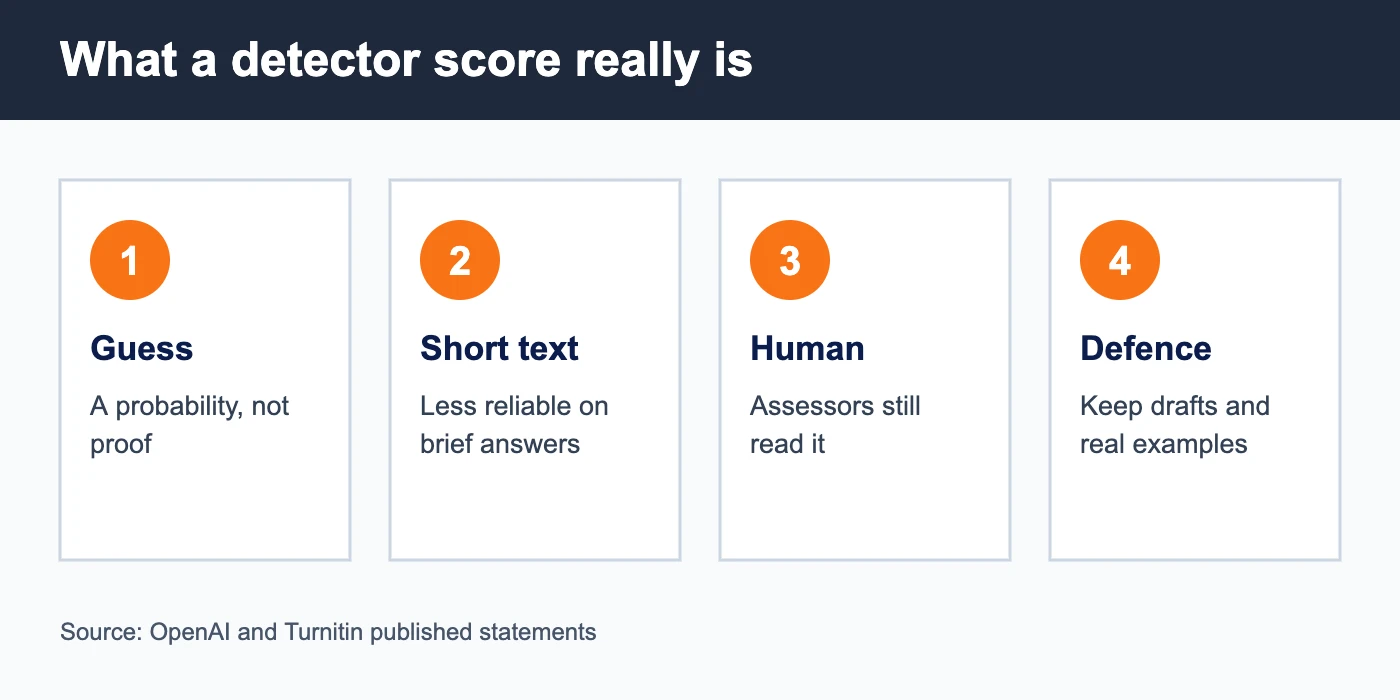
A detector estimates how likely it is that text was machine-written. It does not identify who wrote it. Turnitin itself hides scores below 20% because its testing found more false positives there, and a CASRAI guide argues a score should prompt further inquiry, not serve as proof. Short cover letters sit near the bottom of what these tools can evaluate.
What graduate employers say they actually check
Employers describe checks that go beyond a single score. PwC says it reviews for duplicate accounts, highly similar responses and indicators of third-party or AI-assisted support, and that it does not use AI to assess candidate performance. BT’s pack, as summarised on our Sky vs BT comparison, warns that its text assessment checks for AI-generated answers. Assessors also read answers and test them at later stages.
How to protect yourself
Write your first draft from real examples, keep your drafts and notes, and use AI only for the allowed tasks in your employer’s guidance. If you are asked how you prepared, AstraZeneca says to be open. The strongest protection is being able to explain every line at interview, which a detector cannot fake for you.
Should you run your own letter through a detector?
A free detector is a rough check at best. A high score does not mean you did something wrong and a low one does not mean you are safe. If you use one, treat it as a prompt to rewrite stiff or generic sentences in your own voice, not as a pass or fail.
How to think about an AI detector score
Understand the score
It is a probability from a vendor tool, not proof of how a letter was written.
Know the limits
Vendors list minimum lengths, thresholds and error rates; short texts are weaker.
Expect human review
Employers still read answers and use later stages to test them.
Keep your evidence
Drafts, notes and real examples show your own work.
Checklist
0 of 4 done
Related guides
Next: the full employer AI rules guide, ChatGPT for CV and cover letter, and the graduate scheme hub. Vendor sources: Turnitin on false positives.
AI detectors and cover letters FAQ
Can employers detect ChatGPT in a cover letter?
Some employers say they check for similar responses and indicators of AI-assisted support, as PwC does. Detection tools give probabilities, not proof.
Are AI detectors accurate?
Vendors publish limits. OpenAI withdrew its own detector for low accuracy, and Turnitin gives a false positive rate that it says holds only above a 20% threshold.
Can a detector flag my own writing?
Yes, false positives exist. Turnitin says a highlighted sentence may be human-written about 4 times in 100.
What should I do if my letter is flagged?
Be ready to show your drafts and explain your examples. Following the employer’s AI rules and writing your own first draft is the best protection.