Graduate jobs glossary: 40 recruitment terms explained in plain English


Home › Student guides › Graduate jobs glossary
Short answer: graduate job adverts use about forty words that nobody explains. The ones that trip people up most are annual income (your yearly pay before tax), pro rata (pay scaled to the hours you actually work), rolling deadline (they close when they have enough people, often before the date), SJT (a test of how you’d handle work situations) and commercial awareness (knowing how the business makes money). Everything else is below, grouped by where you’ll meet it.
I spent years writing recruitment adverts, and I’ll admit the industry has its own dialect. Some of it is shorthand that saves recruiters time; some of it is there because “we’ll close early if we get a lot of applications” doesn’t sound great in a job post. This glossary translates both. Where a term has a fixed legal or official meaning, I say so and point to the source. Where it’s just recruiter habit, I tell you what it usually means in practice.
Labels used below: Official means the meaning is set by law, a regulator or a government body. Common use means it’s how employers generally use the word, and one firm may use it slightly differently, so always read their own FAQ.
On this page
Search the graduate jobs glossary
Type a word you’ve seen in an advert, or tap a group. The list filters as you type. If a word you need is missing, it’s probably in one of the longer sections below, which explain the terms in more depth and with examples.
Glossary finder
A word of warning before you rely on any glossary, including this one: employers sometimes bend terms. I’ve seen “assessment centre” used for a single 40-minute video call and “rotational” used for a scheme where you stay in one team and visit two others for a week. The definition tells you what the word normally means; the employer’s own process page tells you what it means for them.
Pay and salary words in graduate job adverts
This is where most confusion sits, and it shows in what people search for. Pay words matter because they decide what lands in your account, and two adverts showing the same number can mean quite different money.
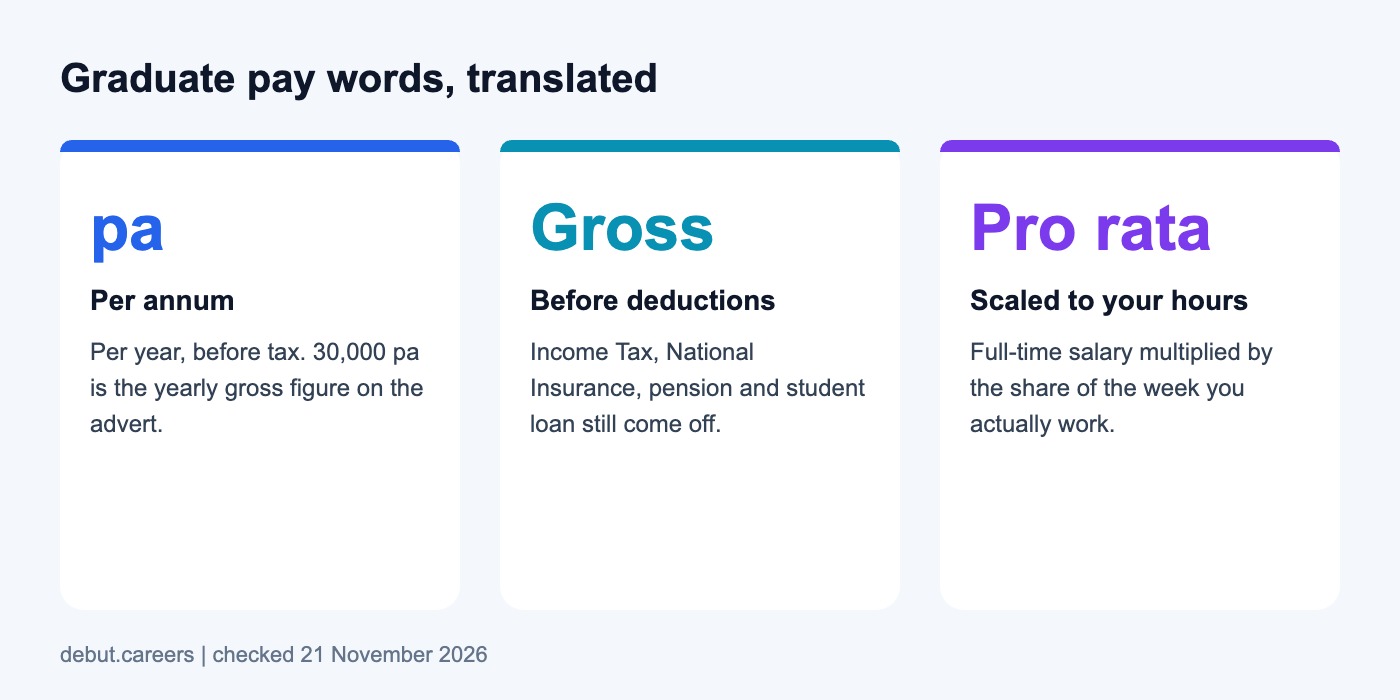
Annual income, annual salary, per annum (pa)
All three mean your yearly pay before tax and other deductions. “£32,000 pa” means £32,000 a year, gross. Annual income can also include things other than salary, such as bonuses or freelance earnings, which is why HMRC talks about income rather than salary. We have a longer piece on what annual income is and how to work it out. Common use
Gross and net
Gross is the figure before Income Tax, National Insurance, pension contributions and student loan repayments come off. Net is what’s left, the money you actually get. Graduate adverts almost always show gross. Our guide to gross vs net salary walks through a real payslip. Common use
Salaried
You’re paid a fixed yearly amount, split into equal monthly payments, rather than by the hour. Nearly every graduate scheme is salaried. It doesn’t mean unpaid overtime is fine; your contract still sets your hours. Common use
Pro rata
Latin for “in proportion”. A part-time job advertised as “£30,000 pro rata” pays £30,000 only if you worked full-time hours. On three days a week you’d get three fifths of it. You’ll see this mostly on part-time and fixed-term roles, less on schemes. Common use
London weighting, location allowance
Extra pay for working in London, either built into the salary or added on top. When a firm lists “£34,000 London, £30,000 regions”, the gap is the weighting. Compare offers in the same city, or you’ll compare the wrong numbers. Common use
Sign-on bonus, golden hello
A one-off payment for joining. Read the small print: some firms ask you to repay it if you leave within a year or two. Common use
Competitive salary
The firm hasn’t published the number. Sometimes it’s genuinely good and they don’t want rivals to see it. Sometimes it isn’t. You’re entitled to ask before an interview, and asking politely won’t count against you with a decent employer. Common use
Salary converter: what does that figure mean per month?
Enter the yearly figure from an advert. This shows the gross amount split by month, week and hour. It doesn’t take off tax, because that depends on your tax code, pension and student loan plan.
A quick reality check on the converter: the hourly figure assumes 52 paid weeks, which is how salaried pay works because holiday is paid. If you’re comparing a salaried scheme against an hourly job, that’s the fair comparison.
Application and deadline words
These are the terms that decide whether your application gets read at all, so they’re worth more of your attention than they usually get.
Rolling deadline, rolling recruitment
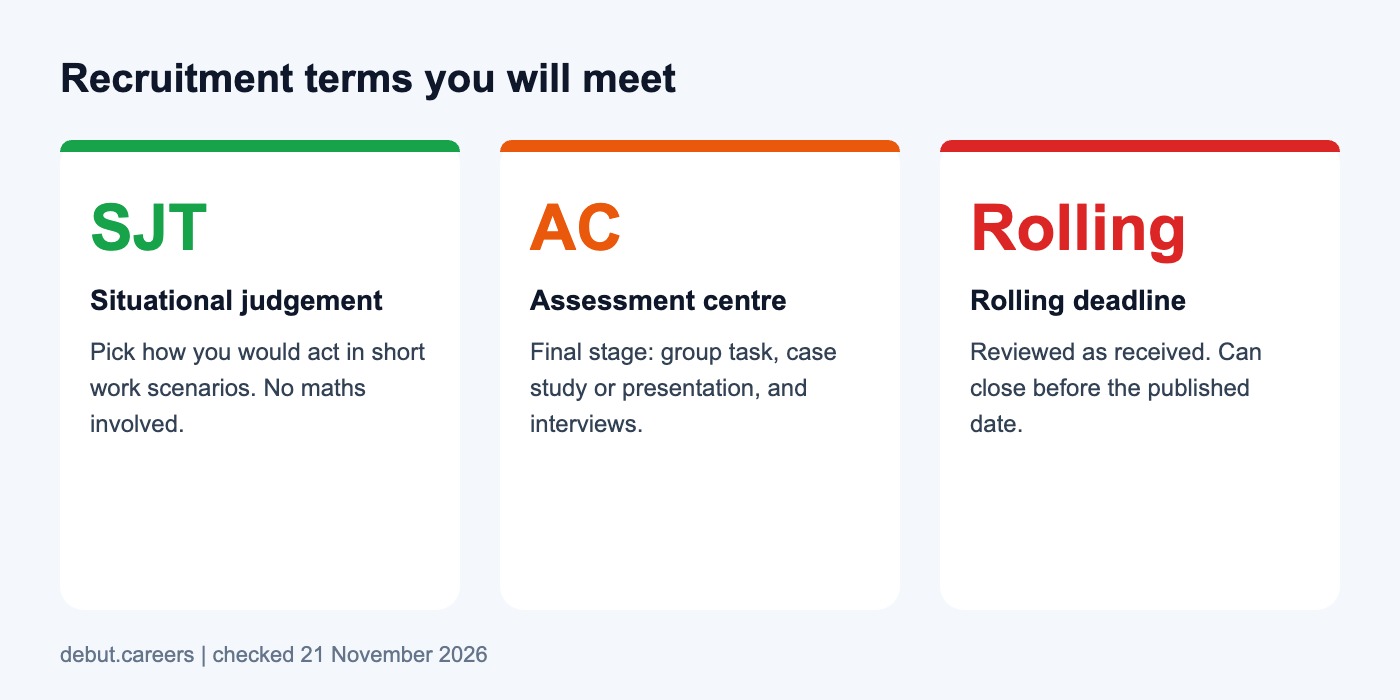
The employer reviews applications as they arrive and can close the scheme when it’s full. The published date is the latest it will close, not a promise it stays open until then. In practice, popular schemes in banking, law and consulting often fill weeks early. If you see “rolling”, apply as soon as your application is good, not when it’s perfect. Our graduate scheme deadlines calendar marks which schemes recruit this way. Common use
Window opens, live date
The date applications start. Some firms publish it; many don’t. “Live” on a jobs board usually means it’s accepting applications today. Common use
Grad scheme vs graduate job
A graduate scheme is a structured programme, usually one to three years, with training, rotations and a cohort who all start together. A graduate job is a normal entry-level role open to graduates, often with a less fixed start date. Neither is better by default. Common use
Rotational programme, rotations
You move between teams or business areas, typically every six to twelve months. Barclays’ HR graduate route, for example, uses three rotations of about eight months each. Common use
2:1, 2:2, minimum requirement
UK degree classifications: first, upper second (2:1), lower second (2:2), third. “Minimum 2:1” means you need at least an upper second, predicted or achieved. More large employers now accept a 2:2 or don’t ask at all, so check rather than assume you’re ruled out. Official (the classification system is set by UK universities)
UCAS points
Points for your A levels or equivalent. Some employers still screen on them, though fewer than a few years ago. If an advert lists a UCAS minimum, it’s a hard filter in the application form. Official (tariff set by UCAS)
Penultimate year
Your second-to-last year at university. Internships and spring weeks often target penultimate-year students because they convert into graduate offers. Common use
Spring week, insight day, vacation scheme
Short work experience. Spring weeks (finance) and insight days are usually for first-years and last a few days. Vacation schemes (law) run one to three weeks and are often the main route into a training contract. Common use
Right to work, sponsorship
Right to work means you can legally work in the UK without the employer’s help. Sponsorship means the employer holds a sponsor licence and can apply for your Skilled Worker visa. If an advert says “we can’t sponsor”, that’s a firm no for anyone who needs it. Official (set by the Home Office)
Tests and assessment words
Every big graduate employer uses some mix of these. The words are mostly standard across firms; the content and difficulty aren’t.
Psychometric tests, online tests, aptitude tests
The umbrella term. Usually numerical, verbal and logical reasoning, timed, taken at home. Our guide to online tests for graduate schemes lists which employers use which providers. Common use
SJT (situational judgement test)
You read short work scenarios and rank or choose responses. There’s no maths. It checks whether your instincts match how the firm wants people to behave, so reading their values page first actually helps here. We list which employers use SJTs and what each one looks like. Common use
Gamified assessment
Short games measuring things like memory, risk-taking or attention. You can’t really revise for them; sleep well and do them somewhere quiet. Common use
Video interview, one-way interview, HireVue
You record answers to questions on screen with no one on the other end. HireVue is one supplier’s name that people use for all of them. You usually get some thinking time and one or two takes. Common use
Strengths-based interview
Questions about what you enjoy and what energises you, rather than “tell me about a time when”. EY is the best-known UK example. Answer honestly and quickly; they’re looking for natural enthusiasm, and polished rehearsed answers stand out for the wrong reasons. Common use
Competency question, STAR
“Tell me about a time you…” questions. STAR (Situation, Task, Action, Result) is the structure most interviewers expect. Keep the Situation short and the Action long. Common use
Assessment centre, AC, final round
The last stage: a half or full day of group exercises, a case study or presentation, and interviews, in person or online. See our student guides for employer-specific AC walk-throughs. Common use
Case study, e-tray, in-tray
A case study gives you a business problem and asks for a recommendation. An e-tray simulates an inbox you have to prioritise under time pressure. Common use
Commercial awareness
Understanding how the business makes money, who its customers and competitors are, and what’s happening in its market right now. It’s the most-requested skill people can’t define. We’ve written a full guide to what commercial awareness is and how to show it. Common use
Offer, contract and first-day words
You’ve got the offer. Now there’s a new set of words, and some of them have legal weight.
Conditional offer
The job is yours if you meet the conditions: usually your final degree result, references, background or credit checks and right to work. If you miss the grade, ask; some firms are flexible, especially if you can explain why. Common use
Probation period
Usually three to six months during which either side can end the contract with shorter notice. It’s normal and almost everyone passes. Common use
Notice period
How much warning you or the employer must give to end the contract. By law, after one month’s employment you must get at least one week’s notice from your employer. Your contract can give more. Official (Employment Rights Act 1996)
Clawback
A clause making you repay something, often a sign-on bonus, relocation or training costs, if you leave early. Law firms and some professional qualification routes use these. Ask about it before you sign, not after. Common use
Deferral
Starting later than the standard intake, for example to finish a master’s. Some firms allow one year; others don’t defer at all. Common use
Cohort, intake
The group of graduates who start together, usually in September. Your cohort becomes your first network, which is one of the underrated parts of a scheme. Common use
Before you sign an offer: quick checklist
Tick each one you’ve checked. 0 of 6 checked
If you’re weighing two offers, the checklist is also a fair way to compare them. The firm with the slightly lower salary but no clawback and an extra week’s holiday can be the better deal over two years.
Sector words: law, finance, consulting, public sector
Each industry layers its own vocabulary on top. This table covers the terms we get asked about most.
| Term | Sector | What it means | Evidence |
|---|---|---|---|
| Training contract | Law | Two years of supervised work at a firm, the traditional route to qualify as a solicitor; now being replaced by QWE under the SQE | Official (SRA) |
| SQE, QWE | Law | Solicitors Qualifying Exam, plus two years of qualifying work experience that can be gained at up to four organisations | Official (SRA) |
| Pupillage | Law (Bar) | The year of training barristers do in chambers | Official (Bar Standards Board) |
| Front, middle, back office | Finance | Client-facing revenue roles; risk and control; operations and technology | Common use |
| Off-cycle internship | Finance | An internship outside the usual summer slot | Common use |
| ACA, ACCA, CIMA | Accounting | Professional accountancy qualifications many audit and tax schemes pay for | Official (ICAEW, ACCA, CIMA) |
| Case interview | Consulting | A spoken business problem you work through with the interviewer | Common use |
| Fast Stream | Public sector | The UK Civil Service graduate leadership programme | Official (Civil Service) |
| Civil Service Success Profiles | Public sector | The framework used to assess behaviours, strengths, ability and experience | Official (Civil Service) |
Sources: Solicitors Regulation Authority, Bar Standards Board, Civil Service Careers; checked 21 November 2026.
If you’re heading into law specifically, our law graduate jobs and schemes guide explains how the SQE changed the route. For finance and accounting, the graduate schemes hub lets you filter by sector and see which schemes are open now.

Questions people ask about graduate job terms
What does annual income mean on a job advert?
It’s the yearly pay before tax, National Insurance, pension and student loan come off. On graduate adverts it almost always means base salary, without bonuses.
What does salaried mean?
You’re paid a fixed yearly amount in equal monthly instalments, rather than by the hour. Your contract still sets your working hours.
What does pa mean in salary?
Per annum, meaning per year. £28,000 pa is £28,000 a year before deductions.
What does a rolling deadline mean?
The employer reviews applications as they arrive and may close early once places are filled. Treat the published date as the latest possible close.
What does commercial awareness mean?
Understanding how a business makes money, who it competes with and what’s happening in its market. Interviewers test it by asking what you’ve read about the firm or its sector recently.
Is a 2:1 still required for graduate schemes?
Some employers still ask for a 2:1, but many large firms now accept a 2:2 or don’t set a degree grade at all. Check each employer’s entry requirements.