Case Interview Guide for UK Graduates: Format, Examples and How to Prepare


A case interview is a live problem-solving conversation where an interviewer gives you a business situation and watches how you think. It is used mainly in management consulting, so you will meet it at firms such as McKinsey and BCG. This guide uses McKinsey’s own interview page and Debut’s BCG guide, and says clearly where a firm does not publish detail.
Facts checked on McKinsey’s careers site, 3 November 2026. We could not find a named consultant quote we can link to, so this guide uses only the firms’ own published words.
What a case interview is
You are given a business problem, for example whether a company should launch a product. You ask questions, structure the problem, work through numbers and give a recommendation. The interviewer is judging your reasoning, not whether you reach one correct answer. Consulting firms often add an online test before interviews; see our numerical reasoning guide and psychometric tests overview.
How McKinsey describes its case interview
McKinsey calls it the Problem Solving Interview, “sometimes referred to as a case interview”. It says it presents a business case to evaluate your approach to complex problems. McKinsey also states there is not one logical solution and advises candidates to listen carefully and share tailored solutions instead of standard frameworks.
For most client-facing roles McKinsey describes two interview types, personal experience interviews and problem-solving interviews, and some roles add an expertise interview. For the personal experience interview it suggests preparing two examples for each of four areas. Source: McKinsey interviewing page.
On AI, McKinsey says using it to practise questions or to explain concepts is encouraged, but generating real-time answers during an interview is not allowed. It also asks candidates to disable AI note-taking tools in virtual interviews.
How BCG describes its interviews
BCG’s UK graduate page says the first-round interview stage includes case-based discussions with senior members of its London consulting team. It does not publish the exact format or number of rounds, so treat any figure you see elsewhere as unverified. The full stages are in our BCG graduate scheme guide.
Official practice cases
McKinsey publishes five sample cases with logic, thought process and suggested answers: Beautify, Diconsa, Electro-Light, Transforming a national education system and Talbot Trucks. Start here before paying for anything, because these show the real style.
How to structure a case interview: five steps
This is Debut’s general method, not an official firm framework.
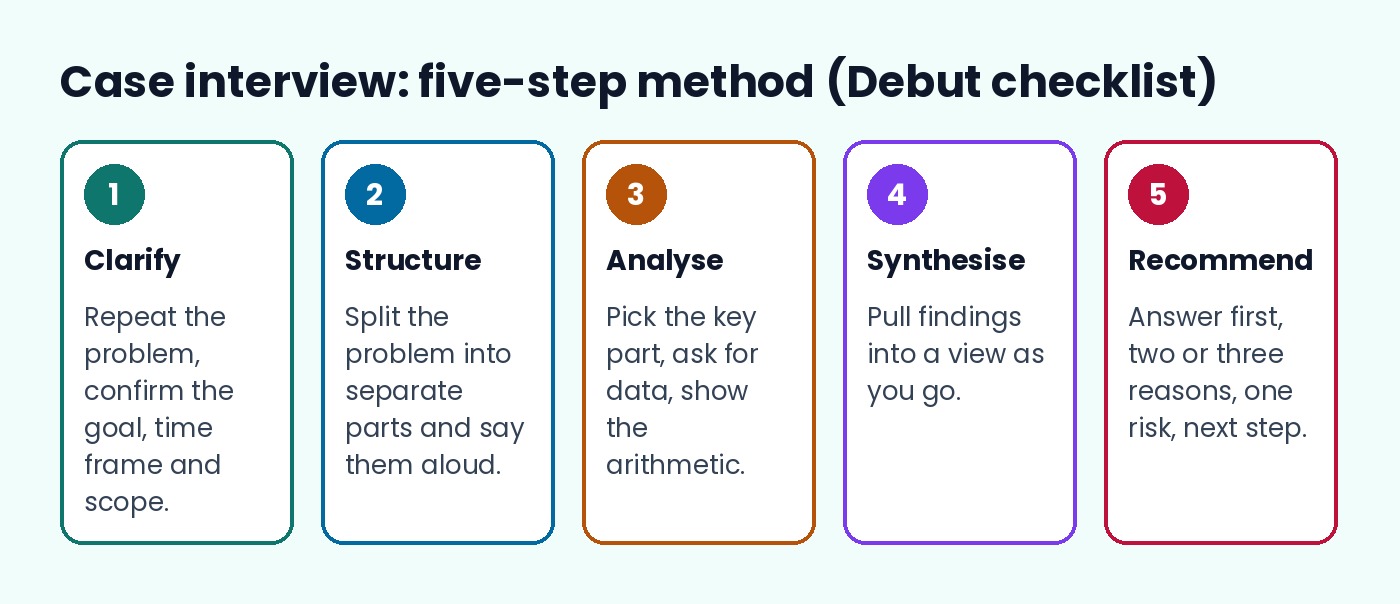
- Clarify: repeat the problem back and ask what the goal is, the time frame and what is out of scope.
- Structure: split the problem into a few separate parts that together cover it, and say them aloud before diving in.
- Analyse: pick the most important part, ask for data and do the arithmetic clearly. State your assumptions.
- Synthesise: pull findings into a view as you go, not only at the end.
- Recommend: give the answer first, then two or three reasons, one risk and a next step.
McKinsey’s own advice is to tailor the approach to the situation, so use these steps as a checklist, not a script.
Worked example: a supermarket delivery case in five steps
The case below is a Debut illustration written to show the method. It is not a real McKinsey, BCG or Bain question. Click each step to see what you would say aloud.
Case: a UK supermarket chain asks whether to launch same-day delivery
Say: So the question is whether the chain should launch same-day delivery, and the goal is profit, not just sales. Can I check the time frame, which cities are in scope, and whether we are judging year-one or year-three profit?
Why it works: you confirm the goal and the limits before touching numbers.
Say: I would look at this in four parts: customer demand, the cost to serve, the competitive response and our ability to deliver. May I take a minute to organise my thoughts?
Why it works: separate parts that together cover the problem, named aloud, give the interviewer a map to follow.
Say: I will start with cost to serve, since it decides whether profit is possible. Could I assume an average basket value, a delivery cost per order and a share of orders that qualify? Let me state those assumptions and do the maths step by step.
Why it works: you pick the most important branch, ask for data and keep the arithmetic visible.
Say: So far, demand looks real but the margin per order is thin, so the case depends on basket size. Let me carry that forward into the competitive question.
Why it works: you build a running view instead of saving the thinking for the end.
Say: I would launch in two dense cities first, because basket size is highest there. Reasons: demand is proven, delivery cost per order falls with density, and the pilot limits risk. The main risk is rivals matching on price, so I would track basket size and cost per order for three months. Next step: agree the pilot cities.
Why it works: answer first, two or three reasons, one risk, one next step.
Debut illustration only. McKinsey says to tailor your approach to each case rather than apply a standard framework, so treat the four parts above as an example of tailoring, not a template.
Four-week case interview prep plan
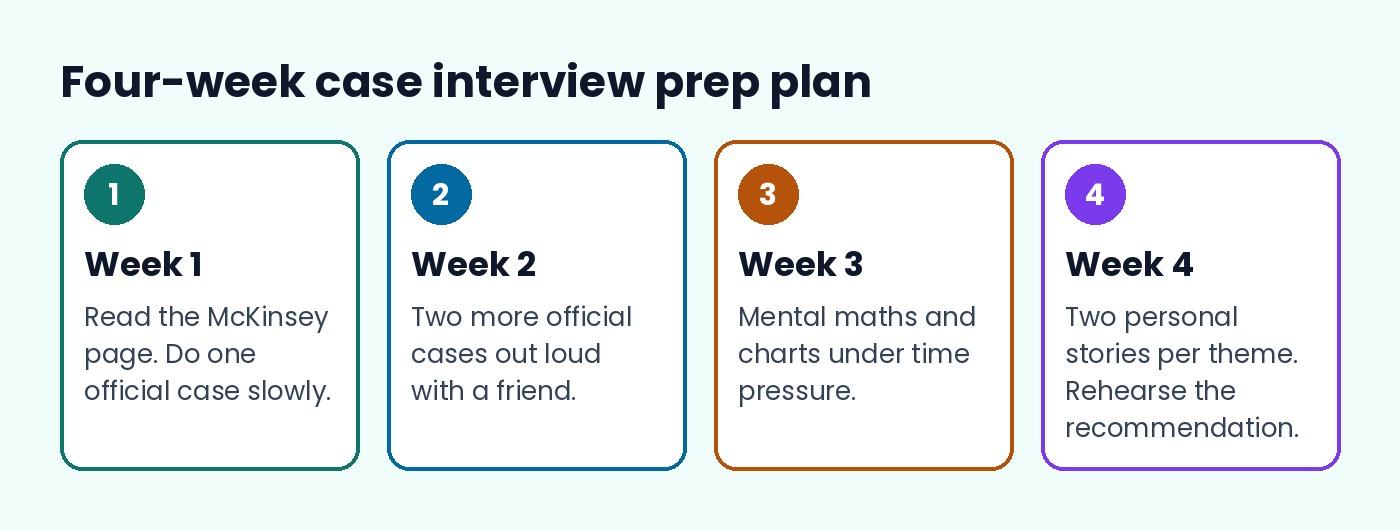
- Week 1: read McKinsey’s page and do one practice case slowly, then compare your reasoning with the suggested answer.
- Week 2: do two more official cases out loud with a friend and ask for feedback on structure and clarity.
- Week 3: practise mental maths and reading simple charts under time pressure.
- Week 4: prepare your personal stories (two examples per theme) and rehearse a short, clear recommendation.
- Throughout: keep a one-page note of mistakes and review it before each session.
Pair this with our assessment centre guide for general habits and our consulting career guide to understand the job you are interviewing for.
Pick a week to see your prep tasks
- Read the McKinsey interviewing page end to end.
- Do one official practice case slowly, then compare your reasoning with the suggested answer.
- Write down where your structure differed.
- Do two more official cases out loud with a friend.
- Ask for feedback on structure, clarity and how you handled the numbers.
- Practise saying your structure in under a minute.
- Practise mental maths and percentages under time pressure.
- Read simple charts and say the one-sentence takeaway.
- Pair this with our numerical reasoning guide.
- Prepare personal stories: McKinsey suggests two examples for each of four areas.
- Rehearse a short, clear recommendation: answer, reasons, risk, next step.
- Review your one-page mistakes note before the interview.
This plan is Debut guidance. No firm publishes a required preparation length.
Case interview mistakes to avoid
- Forcing a memorised framework onto every case. McKinsey says to share tailored solutions.
- Going silent while calculating. Say what you are doing.
- Using AI to generate answers live. McKinsey lists this as not allowed.
- Ending without a clear recommendation.
Case interview compared with other consulting stages
Consulting processes mix several stages. Use the filter to see which statements come from an employer and which are Debut guidance.
| Stage | What it involves | Evidence |
|---|---|---|
| Problem Solving Interview | McKinsey presents a business case; there is no single logical solution | Official |
| Personal Experience Interview | McKinsey suggests preparing two examples for each of four areas | Official |
| First-round interviews at BCG UK | Includes case-based discussions with senior London consulting team members; format and rounds not published | Official |
| Numerical or online test | Often used before interviews; check each employer | Debut guidance |
| Spoken recommendation | Answer, reasons, risk, next step | Debut guidance |
Virtual interview and AI rules
McKinsey says candidates are encouraged to use AI to practise questions and have concepts explained, but generating answers in real time during an interview is not allowed, and it asks candidates to disable AI note-taking tools in virtual interviews. Open the sections below for a practical checklist.
Before the call (Debut tips)
Test your camera and audio, close other apps, have paper and a pen ready, and turn off any AI note-taking tool.
During the call (Debut tips)
Say your structure aloud, narrate your calculations, and pause briefly before answering rather than rushing.
Afterwards (Debut tips)
Write down what the interviewer pushed on and add it to your mistakes note for the next round.
Named quote: we did not find a short, linkable quote from a named McKinsey or BCG interviewer for this page, so none is included. Debut will add one when a verifiable source is found.
Frequently asked questions
What is a case interview?
A live business problem the interviewer gives you so they can see how you structure and solve it. McKinsey calls its version the Problem Solving Interview.
Do UK graduate schemes use case interviews?
Consulting firms do. BCG’s UK page says first-round interviews include case-based discussions, and McKinsey describes problem-solving interviews for most client-facing roles. Other employers may use shorter business cases at assessment centres.
How long should I prepare?
There is no official figure. A four-week plan with several out-loud practice cases is a sensible start, but the right amount depends on your starting point.
Can I use ChatGPT to prepare?
McKinsey says practising questions and asking AI to explain concepts is encouraged. Generating answers during the interview is not allowed.
Are McKinsey’s practice cases enough?
They show the real style and include suggested answers. Add live practice with a person so you can improve how you talk through your reasoning.