Verbal Reasoning Test for Graduate Jobs: Format, Examples & Tips

Rolling Used by many graduate employers year-round. Timings and question counts differ by provider.
27 October 2026
A verbal reasoning test checks whether you can read a short passage and judge statements about it accurately under time pressure. SHL, one of the main providers, describes it as “a passage of text followed by one or more statements” and asks you to decide if each is true, false or cannot be said (SHL example questions). This guide separates what SHL publishes from what third parties report, and links to our graduate online tests guide and the Watson Glaser guide.
Verbal reasoning test: key facts at a glance
| Item | What we know | Source |
|---|---|---|
| Format | Passage of text followed by statements | Official |
| Answer options | True, false or cannot say (SHL style) | Official |
| Practice | SHL offers full-length practice tests and example questions | Official |
| Typical length | About 30 questions in 17 to 19 minutes (SHL style); sources disagree | Reported |
| Adaptive versions | Some tests, such as Talent Q Elements, adapt difficulty to your answers | Reported |
| Exact test used by an employer | Set per employer and per year; ask the recruiter | Not published |
Checked on 27 October 2026. Third-party timings come from test-prep sites, not from the publishers.
How the verbal reasoning test works
| What you read | A passage of text, then one or more statements about it. | Official |
| What you decide | Whether each statement is true, false, or cannot be said from the passage. | Official |
| Time per question | Reported at roughly 40 to 60 seconds in SHL-style tests; check your invitation. | Reported |
| Pass mark | Employers do not publish the score they require. | Not published |
Try the SHL verbal example first, then a full-length test on the SHL practice tests page. SHL says practice tests give a similar experience, not an exact copy of a live test.
True, false or cannot say: the rule that wins points
Answer only from the passage. “Cannot say” is correct when the passage neither supports nor rules out a statement, even if you know the answer from real life. This is the most common place candidates lose marks.
Words that change an answer
Watch for absolute words such as all, only, never and always, and for softer ones like some, may and often. A statement that turns “some” into “all” is usually false or cannot be said.
How to practise in a week
Do one short timed set a day, review every wrong answer to see whether you added outside knowledge, and finish with one full-length practice test. Read business news in the evenings so passages feel familiar. This is our advice, not employer guidance.
Which employers use it
Test-prep sites report that large firms including PwC, Deloitte and KPMG use SHL-style verbal tests. Confirm with your invitation. See our PwC assessment centre guide and the graduate scheme hub for employer pages.
What a graduate says
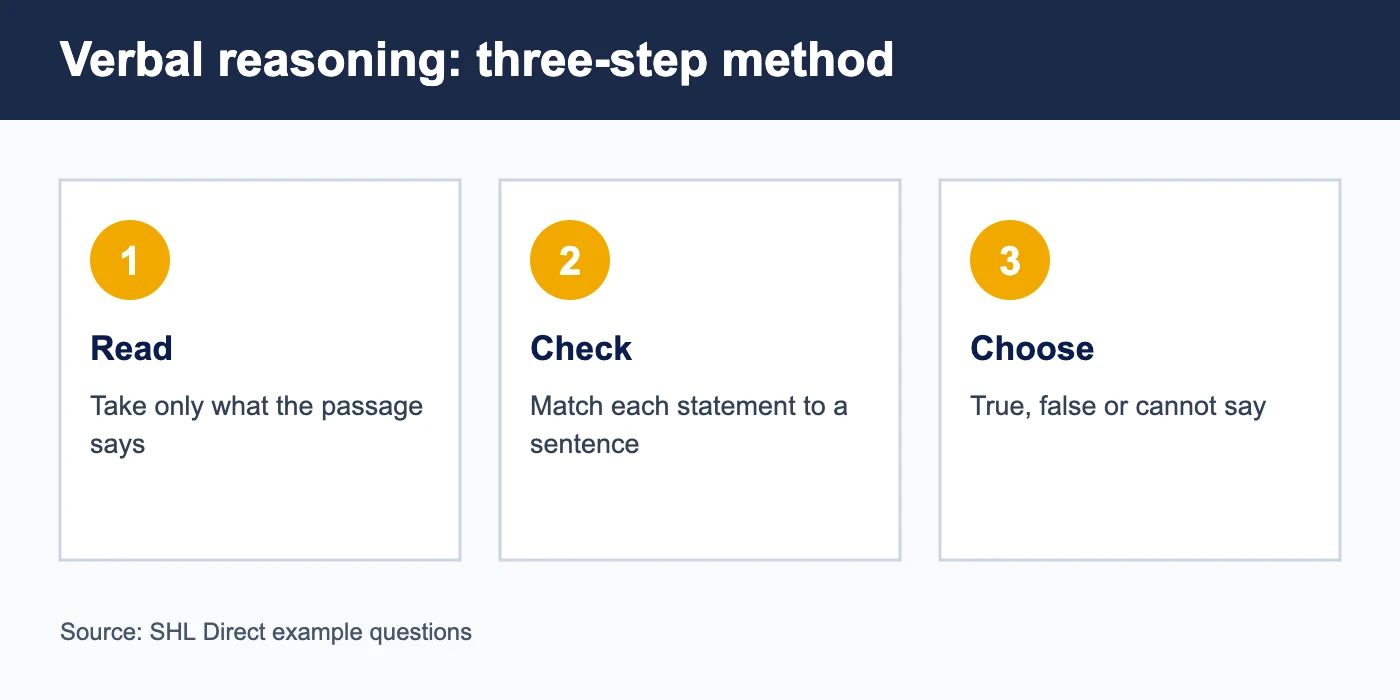
Step 1: read the passage once, carefully
Skim for structure, then read for detail. Do not assume anything the text does not say.
Step 2: test each statement against the text
Find the sentence that supports or contradicts it. If you cannot find one, think cannot say.
Step 3: manage the clock
If a question stalls you, answer your best guess and move on. Time lost on one item costs several later ones.
Step 4: keep your own opinions out
Even a statement you believe is true is wrong if the passage does not say it.
What a graduate says
We looked for a named graduate describing this test in their own words on the official SHL pages and found none, so there is no quote here. We do not invent them.
Checklist
0 of 5 done
Verbal reasoning compared with other tests
Watson Glaser measures critical thinking with a similar passage style, so the two overlap; read the Watson Glaser guide. For number-based questions see our numerical reasoning guide, and for the full picture see graduate online tests.
Verbal reasoning test FAQs
What is a verbal reasoning test?
A timed test where you read a passage and judge statements as true, false or cannot say. SHL describes it as a passage followed by one or more statements.
How many questions are in a verbal reasoning test?
It varies. Third-party sources report about 30 questions in 17 to 19 minutes for SHL-style tests, but employers choose the version, so check your invitation.
What does cannot say mean?
It means the passage does not give enough information to call the statement true or false. Use only the passage, not outside knowledge.
Can I practise for free?
SHL provides example questions and a practice tests page. Other providers have their own samples.
What score do I need to pass?
Employers do not publish pass marks, so treat any figure you see online as unverified.