Deloitte vs EY Graduate Scheme 2027: Process, Limits and Deadlines


The main difference between the Deloitte vs EY graduate scheme choice is not prestige. It is the rules around how often you can apply and what each process asks of you. This comparison sets the two firms’ own published rules side by side and marks every row as Official (from the firm) or Reported (from a third party). It does not compare pay, because the application pages we used do not cover it.
We could not find a quote from a named current trainee for both firms in sources we could check, so this page contains no quote rather than an unverified one. For each firm in depth, read our Deloitte graduate scheme guide and EY graduate scheme guide.
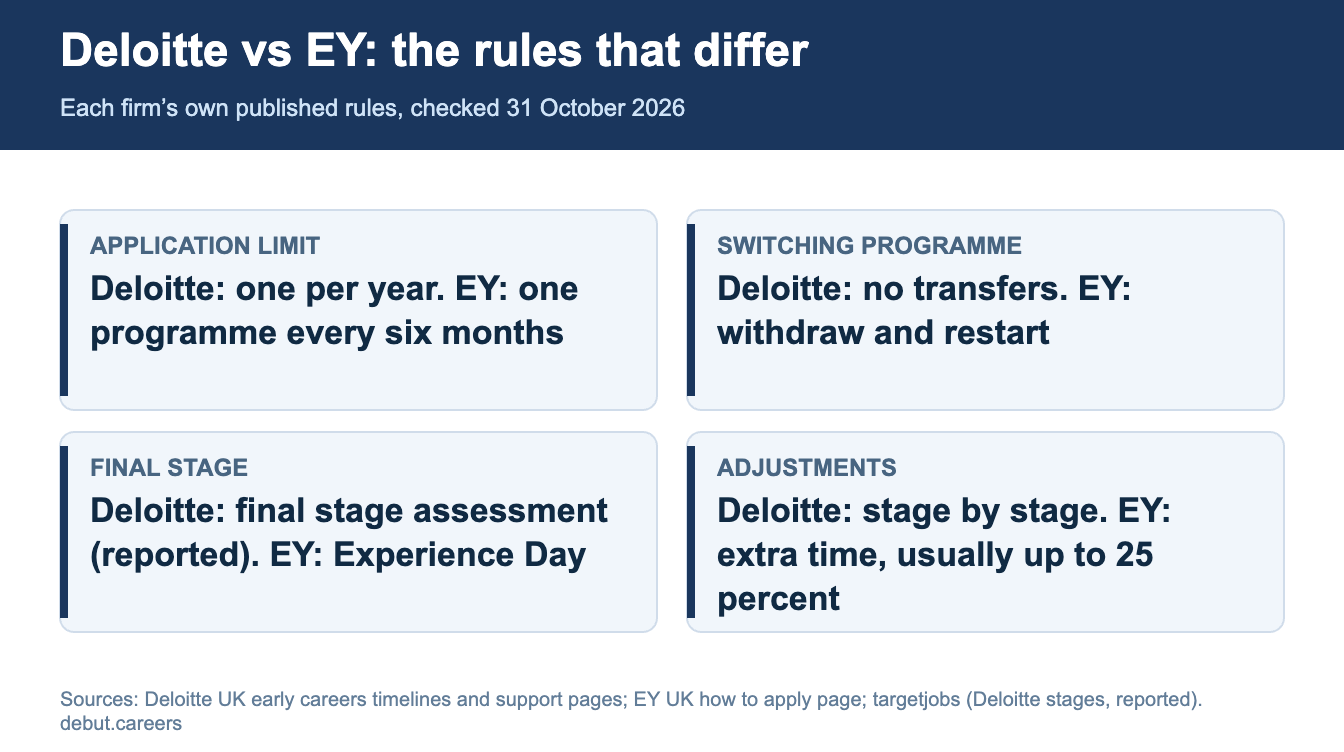
Deloitte vs EY graduate scheme at a glance
| Aspect | Deloitte | EY | Evidence |
|---|---|---|---|
| Business areas | Audit and Assurance, Actuarial, Advisory, Consulting, Enabling Functions, Legal, Real Estate, Tax Consulting, Technology | Assurance, Business Enablement, Consulting, EY-Parthenon, Tax | Official |
| Application limit | One application per year across early careers roles | One programme every six months | Official |
| After a rejection | Apply again in the next academic year (reported) | Wait six months for graduate or undergraduate roles, three months for apprenticeships or Career Starters | Official for EY, Reported for Deloitte |
| Switching programme | Applications cannot be transferred to a different role | You can withdraw, but must restart from the beginning; no swaps | Official |
| Closing early | Roles can close early when volume is high | Roles close once filled or on high volume | Official |
| Process shape | Five stages: application, immersive online assessment, job simulation, final stage assessment, outcome | Application form, online assessment, EY Experience Day, joining | Reported for Deloitte, Official for EY |
| Online assessment | Immersive assessment of about 30 minutes, then a job simulation of about 40 minutes with video answers | Realistic Job Preview covering teamwork and learning capability, plus a behavioural skills test | Reported for Deloitte, Official for EY |
| Final stage | Prepared topic discussion of about 30 minutes plus an interview of about 50 minutes, alongside other candidates | EY Experience Day: meet people, showcase skills, ask questions. Format details not published on the page | Reported for Deloitte, Official for EY |
| Practice material | Candidate Zone | Preparation hub inside the assessment portal | Official |
| Adjustments | Requested stage by stage; extra time and alternative interview formats offered | Extra time, usually up to 25 percent; no medical evidence needed during recruitment | Official |
| Opening dates | Set by business area, from 21 September to 5 October for most graduate areas | 2027 applications described as open; per-programme dates are on programme pages | Official |
Sources: Deloitte’s application timelines page, Deloitte’s application support page, EY’s how-to-apply page, and for the Reported Deloitte rows the targetjobs guide to the Deloitte process (17 April 2025).
The biggest difference: how often you can apply
Deloitte runs a strict one application per year policy across early careers roles, and says an application cannot be moved to a different role. EY lets you apply for one programme every six months and says that after a rejection at any stage you wait six months for graduate or undergraduate roles. Both say you cannot swap mid-process. So at Deloitte a wrong choice costs you the year, and at EY it costs you six months. Choose the programme and location before you press submit.
Process side by side
Deloitte: five stages (reported)
Online application, an immersive online assessment of about 30 minutes, a video-based job simulation of about 40 minutes, a final stage assessment with a prepared topic discussion and an interview, then the outcome. Detail in our Deloitte assessment centre guide.
Evidence: Reported by targetjobs, April 2025. Deloitte’s own pages we read do not list the stages.
EY: application, assessment, Experience Day (official)
EY describes an application form, assessment preparation in a hub inside the assessment portal, an assessment that includes a Realistic Job Preview and a behavioural skills test, and an EY Experience Day as the final stage. EY says reaching the final stage means you have already shown the potential and skills it looks for.
Evidence: Official, from EY’s how-to-apply page.
What neither firm publishes
Neither page we used gives pass rates, the exact length of EY’s assessments, or whether the final stage is in person or online. Treat any site claiming exact pass rates as unsourced unless it names the firm’s own data.
EY’s key skills against Deloitte’s values
EY lists eight key skills on its how-to-apply page: proactive, doing the right thing, curious, building relationships, agility, critical thinking, embracing technology, and being motivated. Deloitte’s values, as reported by targetjobs, are lead the way, serve with integrity, take care of each other, foster inclusion, and collaborate for measurable impact. Prepare examples that fit both, but use each firm’s own language only where it is natural.
Which should you apply to?
Because each firm’s limit is separate, the stated rules do not stop you applying to both. Pick on the business area and location you want, and use the stage differences to plan your practice: video answers and a prepared topic for Deloitte, a Realistic Job Preview and behavioural skills test for EY. For wider context see PwC vs Deloitte and KPMG vs EY, or the full graduate scheme hub.
Before you apply to Deloitte or EY
0 of 4 confirmed. Tick each point that applies to you.
Frequently asked questions
Can I apply to both Deloitte and EY?
Yes. The limits we found are set by each firm separately: Deloitte allows one application per year across its early careers roles, and EY allows one programme every six months. Neither page says an application to the other firm counts against you. Read both policies on Deloitte’s application timelines page and EY’s how-to-apply page.
Which firm closes first?
Neither publishes a single closing date. Deloitte says roles can close early on high volume and opened most graduate areas between 21 September and 5 October. EY says 2027 applications are open and that positions close once filled or on high volume. Apply early to either.
Is the Deloitte or EY process harder?
We cannot rank them. Deloitte’s stages are reported by targetjobs, EY’s are described on its own site, and neither firm publishes pass rates in the pages we checked. The practical difference is the shape: Deloitte includes a video job simulation and a prepared topic discussion, while EY describes a Realistic Job Preview, a behavioural skills test and an Experience Day.
What if I fail a stage?
EY states a six-month wait for graduate and undergraduate roles after a rejection at any stage. Deloitte’s pages we read do not state a wait, but its one-application-per-year policy means your next try would be the following recruitment year. targetjobs says you can apply again in the next academic year.
Where can I compare pay?
Pay is not covered on the application pages we used for this comparison. See our Deloitte guide and our EY guide, and check the advert for your programme.
Sources
- EY UK: How to apply (official, checked 31 October 2026)
- Deloitte UK: Early Careers Application Timelines (official, checked 31 October 2026)
- Deloitte UK: Early Careers Application Support (official, checked 31 October 2026)
- targetjobs: Your guide to the Deloitte application process (editorial, 17 April 2025)