Fast Stream vs NHS Graduate Scheme 2027: Which Should You Apply To?

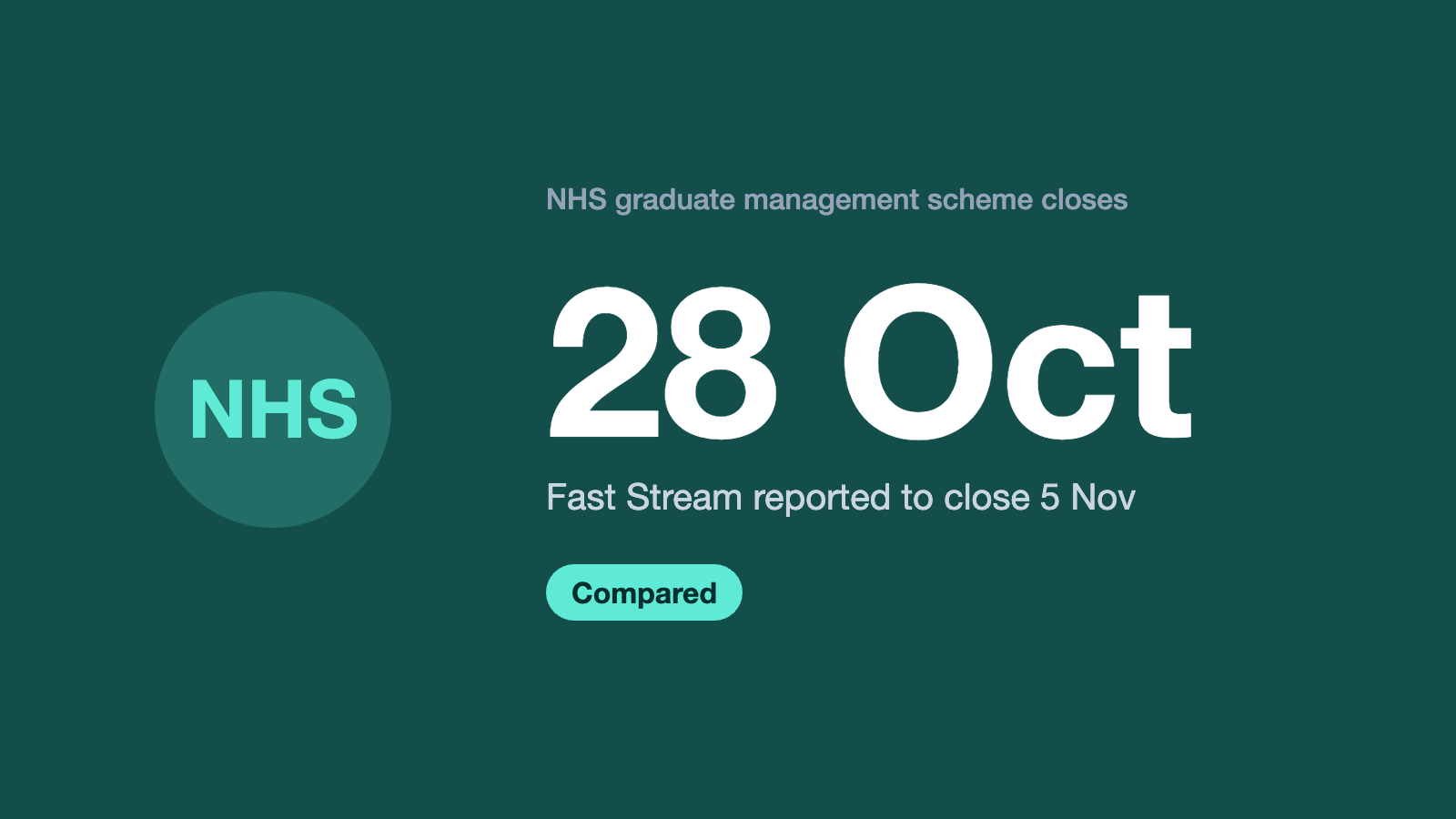
Closing soon NHS GMTS closes 28 Oct 2026 at 11:30am. Fast Stream closes midday 5 Nov 2026. (… days left)
Official. Both schemes checked on their own pages on 21 Oct 2026; comparison written 26 Oct 2026.
The Civil Service Fast Stream and the NHS Graduate Management Training Scheme are the two big public-sector leadership routes for 2027 entry. They pay almost the same, both accept a 2:2 on most routes, and their application windows close eight days apart. This guide puts the facts side by side from each scheme’s own pages, so you can decide where to spend your time. Single-scheme detail is in our Civil Service Fast Stream guide and our NHS graduate scheme guide.
Fast Stream vs NHS graduate scheme 2027: side by side
| Factor | Civil Service Fast Stream | NHS GMTS | Evidence |
|---|---|---|---|
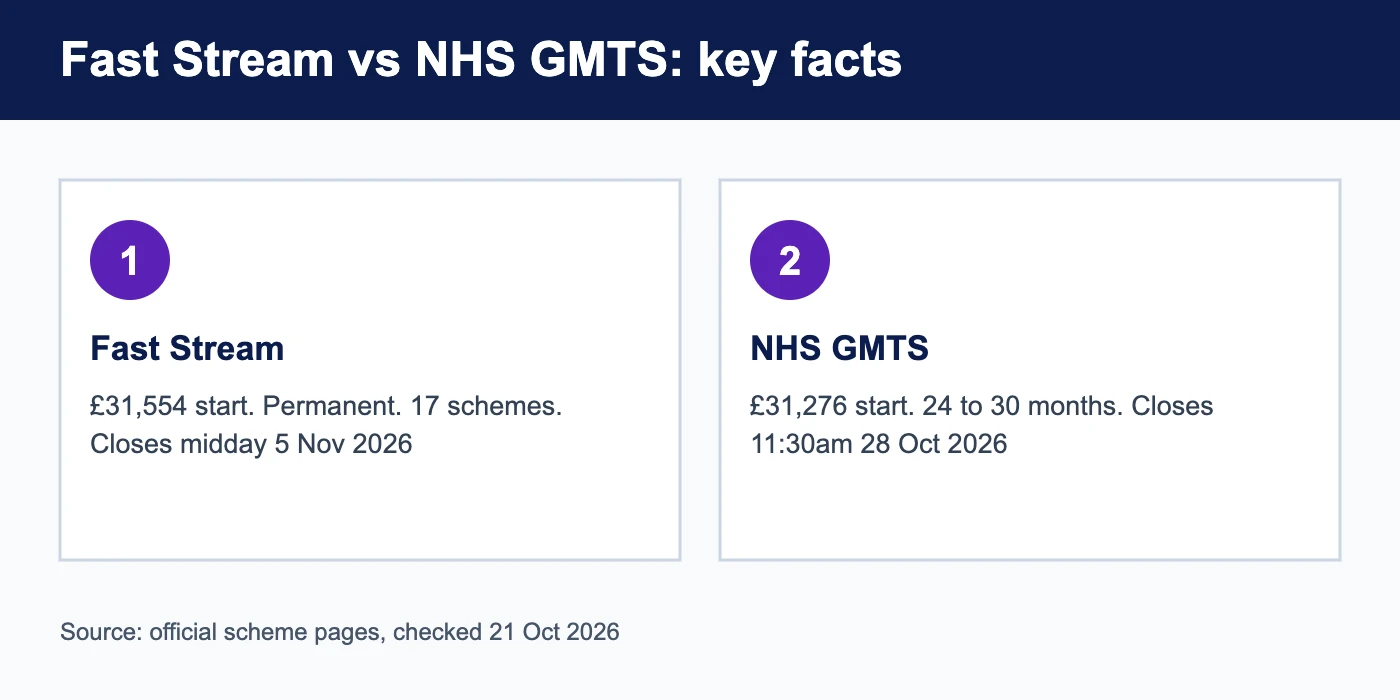
| Closing date | Midday, 5 Nov 2026 | 11:30am, 28 Oct 2026 | Official |
| Starting salary | £31,554 | £31,276, rising to £33,681 after 12 months | Official |
| Pay after the scheme | £45,000 to £55,000 earning potential on completion | Around £44,000 average in the first NHS role after the scheme (NHS figure) | Official |
| Contract | Permanent | Fixed-term: 24 months, or 30 months for Finance and Engineering and Estates Management | Official |
| Routes | 17 schemes; up to 3 per application | 5 pathways: General Management, Finance, HR, Digital (Health Informatics), Engineering and Estates | Official |
| Degree | A 2:2 in most schemes; check each scheme | A 2:2 in any subject for most pathways; Engineering and Estates needs an accredited engineering degree (not MEng) | Official |
| Online stages | Online tests: untimed, 7 days to complete | Future Potential Assessment (about 45 min), then Alignment Assessment with video (about 60 min) | Official |
| Assessment centre | Online, half a day; Final Selection Board for some schemes | Virtual, half a day, January to February 2027 | Official |
| Success rate | 1.0% for 2026 entry (703 recommended from 69,046 first-preference applications) | Not published | Official / Not published |
| Start | September or October the year after you apply | First Monday of September 2027 | Official |
| Transparency Index | 5 out of 5 | 5 out of 5 | Our index |
Evidence: Official means taken from the scheme’s own pages. Not published means we found no figure.
At a glance: what each scheme states
| NHS GMTS deadline | Closes 28 Oct 2026 at 11:30am | Official |
| Fast Stream deadline | Closes midday 5 Nov 2026 | Official |
| NHS salary | £31,276, then £33,681 after 12 months | Official |
| Fast Stream salary | £31,554 starting | Official |
| Fast Stream success rate | 1.0% for 2026 entry | Official |
| NHS success rate | No figure found on the pages we checked | Not published |
| Applying to both | The pages we checked do not say whether you can apply to both in one year | Not published |
Evidence labels: Official = the scheme’s own pages; Not published = no figure found. See our Transparency Index for how we score pay, dates and stages.
The biggest difference: contract and career path
The NHS scheme is a fixed-term training contract of 24 months (30 for Finance and Engineering and Estates), focused on health management. The Fast Stream is a permanent civil service contract with postings across government departments in one of 17 streams. If you want to specialise in running health services, the NHS route is built for it. If you want a generalist government career or a specialism such as digital, finance, economics or policy, the Fast Stream offers more streams to choose from.
Fast Stream vs NHS graduate scheme: pay
The starting pay is close: £31,554 on the Fast Stream and £31,276 on the NHS scheme, which rises to £33,681 after 12 months. Both schemes publish what they expect you to earn afterwards, but the figures measure different things: the Fast Stream states £45,000 to £55,000 earning potential on completion, while the NHS says trainees earn around £44,000 on average in their first NHS role. Use our paycheck calculator to see take-home pay on each salary.
Who can apply
Both accept a 2:2 on most routes. The NHS pathways are more specific: Engineering and Estates needs an accredited Mechanical, Electrical or Building Services Engineering degree, and MEng applicants are not eligible for that pathway. The Fast Stream sets nationality rules per scheme: it is broadly open to UK, Irish and Commonwealth nationals and some EU nationals with the right to work, but some schemes, such as Diplomatic and Development, require British citizenship. The NHS requires the right to work in the UK for the whole scheme.
How selective is each scheme
For 2026 entry the Fast Stream recommended 703 people from 69,046 first-preference applications, a 1.0% success rate, ranging from 0.2% to 4.7% depending on the scheme. We could not find a comparable success rate for the NHS scheme, so we do not claim one is easier. What the pages do show is that the Fast Stream asks you to rank up to three schemes, and which ones you pick changes your odds.
Application stages compared
NHS stage 1: registration and application form
Create your account and submit the form. The NHS says the earlier you apply, the more time you have for the assessments.
NHS stage 2: Future Potential Assessment
Online, about 45 minutes.
NHS stage 3: Alignment Assessment
Includes video responses, about 60 minutes. Only the recording is timed, so plan a short structure for each answer in the preparation time.
NHS stage 4: Virtual Assessment Centre
Half a day, January to February 2027, with the outcome an offer, reserve list or unsuccessful.
Fast Stream stage 1: initial application
Register one account, choose up to three schemes and give background information.
Fast Stream stage 2: online tests
Work-based scenarios and a case study. Untimed, with 7 days to complete.
Fast Stream stage 3: Assessment Centre
Online, half a day: a written advice exercise, a stakeholder communication role-play and a 30-minute personal development conversation.
Fast Stream stage 4: Final Selection Board
Not every scheme has one: Government Policy, Cyber Security and Digital do not.
What a graduate says
“…an organisation that wanted to develop me as a future leader.”
John, General Management trainee, NHS GMTS. Source: trainee story on the scheme’s own site. One trainee’s account, published by the employer.
“I did it with a lot of perseverance.”
Folashade Atiko, strategy adviser, joined the Fast Stream policy scheme at her fourth attempt. Source: GOV.UK case study, 9 May 2025. One person’s account, not a typical route in.
Checklist
0 of 7 done
Fast Stream vs NHS graduate scheme: which should you apply to?
Choose by the career you want, not by the salary: pay on day one is within £300. Pick the NHS scheme if you want to lead health services and are happy with a fixed-term training contract; its window closes first, on 28 October. Pick the Fast Stream if you want a permanent civil service job with a choice of 17 streams and can handle a more competitive process. The pages we checked do not say whether you can apply to both in the same year, so confirm that on the official sites before you plan to. For other routes see our graduate schemes hub, the MI5, MI6 and GCHQ graduate schemes, our assessment centre guide and the online tests guide, and check closing dates in our deadlines calendar.
Fast Stream vs NHS graduate scheme: FAQ
Which closes first, the Fast Stream or the NHS scheme?
The NHS Graduate Management Training Scheme closes first, on 28 October 2026 at 11:30am. The Fast Stream closes at midday on 5 November 2026.
Which pays more, the Fast Stream or the NHS scheme?
£31,554 on the Fast Stream versus £31,276 on the NHS scheme, which rises to £33,681 after 12 months.
Do I need a 2:1 for either scheme?
No. Both accept a 2:2 on most routes, though some NHS pathways and Fast Stream schemes set extra requirements.
Is the NHS scheme permanent?
No. It is a fixed-term contract of 24 months, or 30 months for Finance and Engineering and Estates Management.
Is the Fast Stream harder to get into?
The Fast Stream success rate for 2026 entry was 1.0%. We found no equivalent figure for the NHS scheme, so we cannot compare them directly.
Can I apply to both in the same year?
The pages we checked do not say. Check the official sites before applying to both.