Watson Glaser test 2027: format, timing and practice questions


The Watson Glaser test is a critical thinking appraisal used by UK law firms and some other graduate employers to decide who moves from the application form to the next stage. It measures how well you evaluate arguments and draw conclusions from text, not what you know. Below: what the publisher says about the format, what three law firms say about how they use it, three practice questions, and how to prepare without chasing made-up “pass marks”.
Our take
The Watson Glaser punishes clever people who know too much. Most marks go on Draw Conclusions and Recognise Assumptions questions where you add something the passage never said. Practise until “only the text counts” is automatic, and do at least one set of 40 questions in 30 minutes even if your firm’s version is untimed.
Watson Glaser test: at a glance
| Item | What the source states | Label |
|---|---|---|
| Publisher | TalentLens (Pearson). Product page: Watson Glaser Critical Thinking Appraisal | Official |
| Scored areas | Recognise Assumptions, Evaluate Arguments, Draw Conclusions | Official |
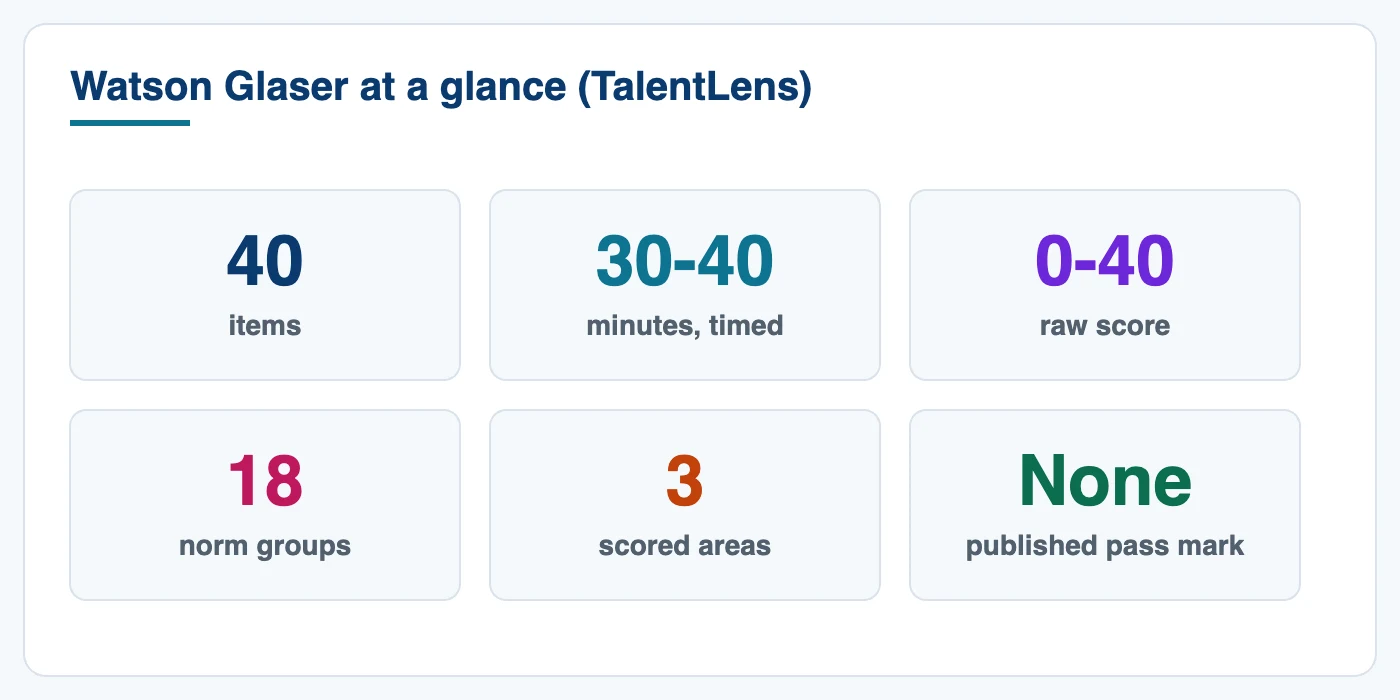
| Length | 40 items; 30 to 40 minutes when timed (TalentLens) | Official |
| Scoring | Raw score from 0 to 40, then a percentile against a norm group; TalentLens lists 18 norm groups | Official |
| Pass mark | No pass mark is published by TalentLens or by the employers below | Not published |
| Free practice | TalentLens practice tests | Official |
What the Watson Glaser actually tests
TalentLens describes the appraisal as measuring critical thinking through three scored areas. Its product page also lists the five classic subtests, so you may see both descriptions: the three-area view is how results are reported, the five-part view is how many older guides describe the questions.
Recognise Assumptions
Evaluate Arguments
Draw Conclusions
Try three practice questions
These are our own questions in the Watson Glaser style, not taken from the real test. Read each passage, choose an answer, then check it. Use only what the passage says.
Draw conclusions
Passage: Every trainee at the firm sits in four departments over two years. Priya is a trainee at the firm and has completed one year.
Conclusion: Priya has already sat in the litigation department.
Recognise assumptions
Statement: “We should open the application window earlier this year so that more students from outside London apply.”
Proposed assumption: Opening earlier would change who applies.
Evaluate arguments
Question: Should graduate schemes stop using online tests?
Argument: “Yes, because online tests are boring for candidates.”
Which employers use it? What they say
| Employer | What its own page states | Source |
|---|---|---|
| Clifford Chance | Watson Glaser of 30 minutes and 40 questions; 4 days to complete; use of AI not permitted | Clifford Chance, how we hire |
| Linklaters | 5 days to complete; the page describes the test as untimed | Linklaters, your application |
| Freshfields | Stages and tests listed on its application page; check it for the current year | Freshfields, how do I apply |
The difference matters: Clifford Chance describes a timed 30-minute format, while Linklaters describes an untimed one. Do not assume the test works the same way at every firm; read the employer’s own page before you start.
How to prepare, in order
- Take the free TalentLens practice test first. It shows the question style before you spend time on paid material.
- Practise “only what the text says”. Most lost marks come from using outside knowledge on Draw Conclusions questions.
- Time yourself at 40 questions in 30 minutes even if your employer’s version is untimed, so a timed one does not surprise you.
- Read the invitation email for the deadline. Clifford Chance states 4 days and Linklaters 5 days.
- Do not use AI tools on the test. Clifford Chance states AI is not permitted.
Checklist before you start
Where it sits in a law-firm application
At the firms above the test comes after the online application and before interviews or an assessment day. For how later stages work, see our graduate assessment centre guide and our PwC assessment centre guide. For deadlines across employers, use the Graduate Scheme Transparency Index and the graduate scheme hub.
Mistakes that cost the most marks
- Using what you know. If the passage doesn't say it, it doesn't count, however obvious it seems.
- Treating "probably true" as "true". In Draw Conclusions there are shades between true and false. Read the answer options every time.
- Calling an argument strong because you agree with it. Strong means important and directly relevant to the question, not right.
- Running out of time on long passages. Questions are worth the same, so move on and come back.
- Using AI or a friend. Clifford Chance says AI is not permitted, and later stages often test the same skill in person.
Watson Glaser test: FAQ
What is a good Watson Glaser score?
Neither TalentLens nor the firms publish a pass mark. TalentLens reports a raw score out of 40 and a percentile against a norm group, and each employer chooses its own cut-off.
How long is the Watson Glaser test?
TalentLens states 40 items and 30 to 40 minutes when timed. Clifford Chance describes 30 minutes and 40 questions; Linklaters describes its version as untimed.
Can I retake it?
Neither the publisher nor the firms say. Ask the employer’s recruitment team before you start.
Is there a free practice test?
Yes. TalentLens, the publisher, lists practice tests on its own site, and the three questions above give you a feel for each section.
Want the dates in one place? See our graduate scheme deadlines calendar, with days left and add-to-calendar links.
See also our guide to graduate online tests: which employers use SHL, Cappfinity and other providers.