
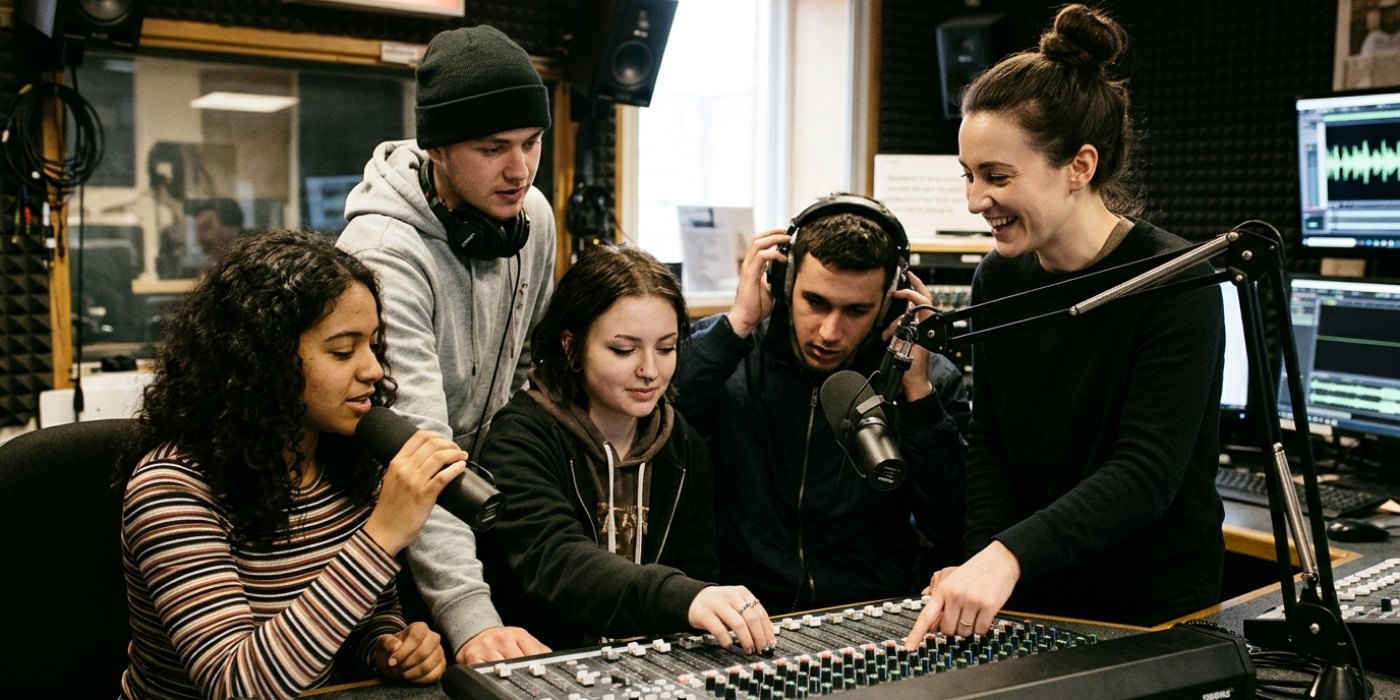
Editorial interview. Not sponsored: Debut asked the questions, and WaterBear did not pay for this piece. Answers are Eve Massaad’s own, lightly edited for style.
Plenty of people now build a career from several roles at once: writing, performing, producing, teaching. That raises a fair question for anyone choosing what to study: should a degree be built around the industry you want to work in, or around a more traditional academic structure? We put five questions to Eve Massaad, CMO at WaterBear, the College of Music, a college of Falmouth University with campuses in Brighton and Sheffield and an online option.
Our take: what this means if you’re choosing a route
- An industry-led degree gives you contacts, live projects and a portfolio while you study. That is valuable in music and other creative fields, where work often comes through people you have already worked with.
- Traditional degrees have their own strengths: broader academic grounding, and often a wider choice of modules and routes into postgraduate study. Neither model suits everyone.
- Whatever you are weighing up, check the course’s outcomes and student satisfaction on Discover Uni, ask who teaches you, and ask current students what they have actually done.
Why did WaterBear build its education model around real-world music industry experience?
The starting point for WaterBear was a simple question: what does someone actually need to build a life in music? Today, an independent artist might write and release their own music, build an audience, book shows and earn money producing or teaching alongside it. That’s what we mean by a portfolio career. It takes time to work out which combination of roles suits you, and that’s something you can start doing while you’re studying.
We built the degrees around that reality. You can bring the music you’re making and the projects you care about into your studies, get feedback from people who are working in the industry and put what you’re learning into practice. For me, that’s the point of an industry-led degree. By the time you graduate, you’ve already started building the career you came to study for.
How does that change what a student’s three years actually look like?
A songwriting student might bring an unfinished track into class, work on it with a producer they’ve met on the course, then play the demo in a one-to-one Artist Development session. They can get feedback there and then on the decisions they’re actually making. Does the groove lift the chorus? Is the bass doing too much under the vocal? What would they change before performing or releasing it?
Through Artist Development, our students can hear from people like Cassell The Beatmaker, drummer for The Streets, and Olivia Thompson, bassist for RAYE. They bring different ears to the same track, shaped by the work they do on stage. For me, that’s where it gets exciting. A student can play a rough demo, hear what a working musician picks up on and go straight back into rehearsal or the studio to try it out.
We now have three WaterBear live music venues, two in Brighton and one in Sheffield. That means a music business student can start by planning how they’d promote a gig in class, see how a venue team takes a show from booking to doors open, and then put on a gig of their own in one of our venues. They come back to class with real decisions to unpack. Did the promotion reach the right people? What happened when the running order changed? What would they do differently next time? That’s how the classroom and the venue feed into each other.
Our Music Industries team brings together artist development, careers and industry, and events. As students’ interests become clearer over the three years, that team can help them find relevant opportunities, from live performances and work experience to masterclasses and feedback on a project they’re developing.
Can you give a few examples of what that looks like in practice?
One I love is Emma Scott, a radio presenter who used her Master’s at WaterBear to grow her business. Her ‘Pluggin Baby’ radio show is now broadcast around the world. For someone who’s already working in music, that’s what postgraduate study can do. It gives you time and support to develop something you’ve started and take it further.
More recently, in 2026, the DJ AG scholarship covered full tuition for Jimmy Curtin, an artist, rapper, singer and producer studying music production at WaterBear Sheffield. We launched it with a livestreamed street session in Sheffield that brought WaterBear students and alumni together with local performers and posted on DJ AG’s platforms to millions of followers. The Ronan Keating scholarship supported a different stage of someone’s career, covering full tuition for Glasgow singer-songwriter Lauren Black to study MA Songwriting.
In Brighton, the WaterBear Venue and WaterBear Music Bar hosted showcases during The Great Escape, with emerging WaterBear artists sharing stages with acts from international showcases. Having working venues gives us a way to offer these super valuable performance opportunities and bring students closer to how a festival comes together and the people who make it happen.
Where do you think traditional music higher education could evolve?
Bringing music higher education up to date with how people work in the industry today is the whole point of what we do at WaterBear. It’s built into how we design our degrees and reinforced by the support students get from our Music Industries team. Since setting up the department, we’ve spent the last couple of years working hard to bring careers and industry into curriculum design from the start.
For me, the opportunity for music higher education is to give students more room to build something of their own while they study. If you’re making a record on your course, you can use that project to learn how to agree songwriting splits with your collaborators, put together a release budget and work out how to reach an audience. You might start out focused on writing the songs and discover you’re just as interested in producing other artists or putting on the launch show. A degree should give you the space to follow those interests and see where they could take you.
What would you say to a school-leaver weighing up their options?
I’d look for a degree that challenges you academically and gets you working with people in the industry from day one. Ask who’s teaching you, what they’re working on in music right now and what you’ll actually get to do in your first year. Can you get feedback on your own work from people making records or touring? Can you get hands-on experience at a gig, in a studio or with an artist team? Ask current students what they’ve done and how they got involved.
You’re choosing where to spend three years, so think about what you want to leave with. Alongside your degree, will you have a stronger CV with hands-on experience and work you’re proud to show? Will you have had the chance to get your work in front of industry professionals and build relationships that could open doors to paid work? For me, that’s a big part of what makes a degree worth doing. You come away with a clearer idea of what you love doing and the experience to build a more sustainable living from it, whether that’s in one role or a mix of roles you enjoy.