Careers in Payments: What Phone Payments Teach Graduates About a Fast-Moving Industry


Partner article: this post includes a commercial partner link.
Every time someone taps a phone at a till, a small chain of companies springs into action. A wallet app, a card network, a bank, a payment processor and the merchant all play a part, usually in less time than it takes to put the phone away. For graduates looking for a career with real variety, that chain is full of jobs most people never think about.
Payments sits where technology, finance, regulation and customer experience meet. It suits people from computer science, economics, law, maths and business backgrounds alike, and the UK is one of the busiest places in the world to work in it.
Why payments is worth a graduate’s attention
Volume is the first reason. Pay.UK’s quarterly report for Q4 2025 lists about 1,455 million Faster Payments transactions worth roughly £1,270 billion in that quarter (reported figures; see the Pay.UK report). Open Banking Limited reported 40.16 million Open Banking payments across the CMA9 banks in June 2026 (reported; see Open Banking). Systems at that scale need people who can manage reliability, fraud and regulation at the same time.
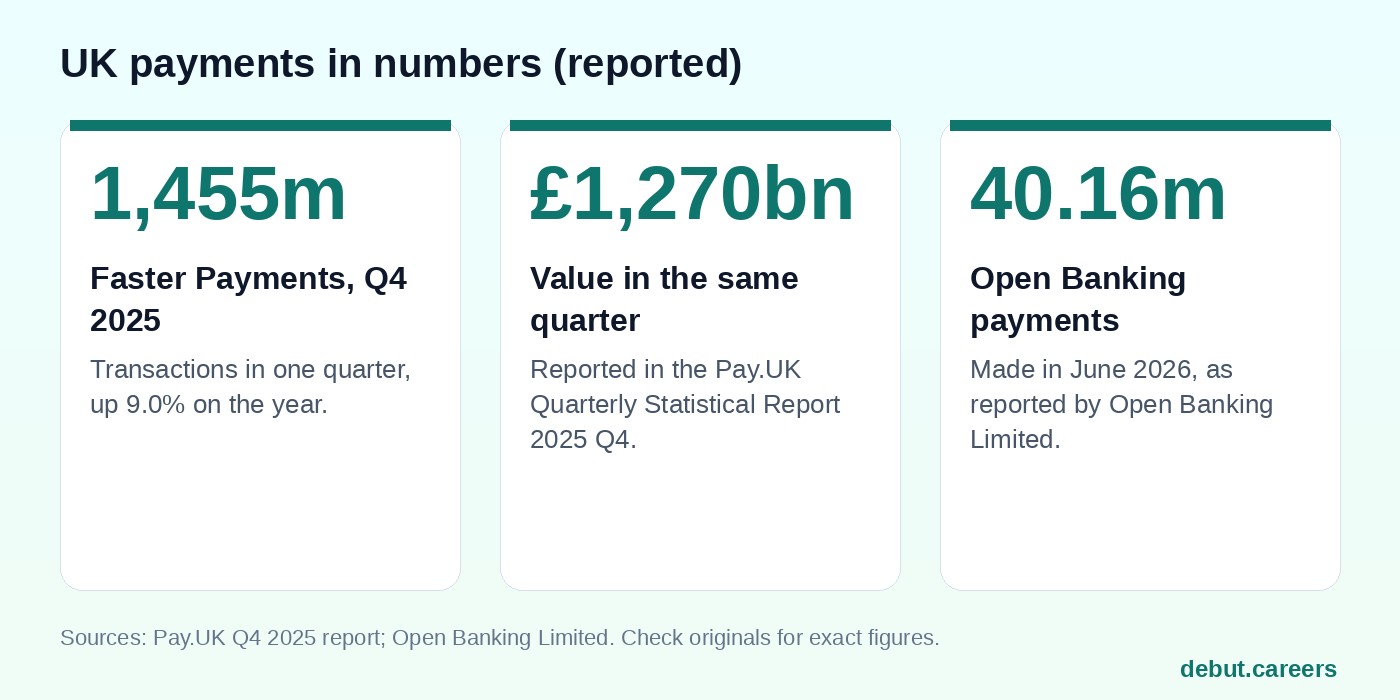
Figure 2. UK payments in numbers (reported).
How a Phone Payment Actually Works
When you add a card to Apple Pay or Google Pay, your phone does not store the card number in the usual way. Instead, the card details are swapped for a digital token tied to that device. When you pay, the token travels through the system, and the merchant never sees your real card number. If the phone is lost, the token can be cancelled without replacing the card.
That process, known as tokenisation, is one of the reasons mobile wallets spread so quickly. It added security while making paying faster, which is the combination every payments team is chasing. Behind it sit product managers who design the user journey, engineers who build the integrations, and risk specialists who decide which transactions look suspicious.
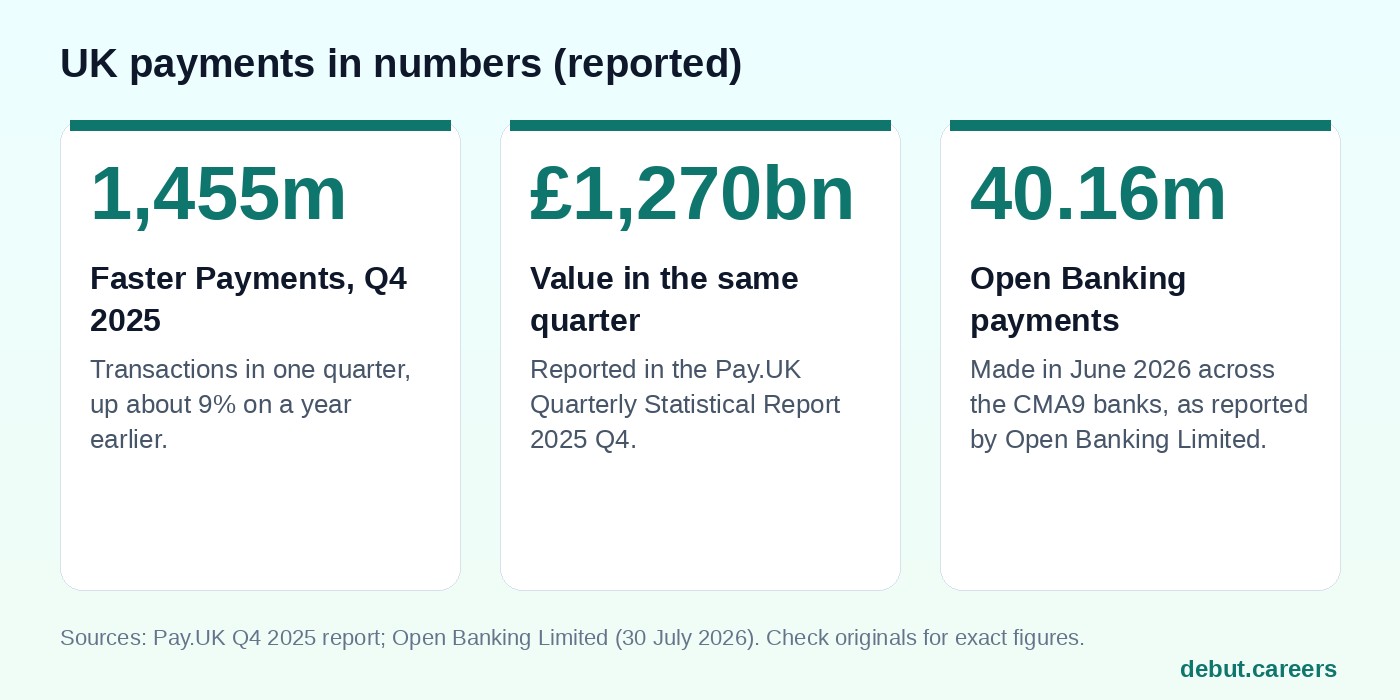
Figure 1. How a phone payment works.
The Older Meaning of Paying by Phone
There is a second, older meaning of paying by phone. Carrier billing lets people add a purchase to their mobile phone bill or deduct it from prepaid credit. It is still used for things like app purchases and digital content, but many businesses have moved away from it in favour of wallets and open banking.
For the businesses involved, carrier billing comes with its own trade-offs. Mobile networks take a share of each payment, and spending caps tend to be low, which suits small digital purchases better than larger transactions.
A Regulated Sector as a Case Study
Regulation shapes payment choices more than most people expect. Since April 2020, Great Britain’s Gambling Commission has banned credit cards for gambling (see the Gambling Commission announcement), which moved operators towards debit cards, bank transfers and mobile wallets. Payment options in this sector, including any pay on phone casino offered by an operator, are shaped by rules like these. Gambling is for adults only (18+) and carries financial risk; free support is available from BeGambleAware. For graduates, the point is the compliance, identity-check and product work behind a payment option, which is a payments job as much as a legal one.
The Roles Behind the Tap
The payments industry hires graduates into a wide range of positions. A few of the most common are:
-
Payments operations analyst, keeping transactions flowing and fixing failures
-
Fraud and financial crime analyst, spotting unusual patterns
-
Product manager, designing how customers pay and get paid
-
Compliance specialist, interpreting rules and turning them into processes
-
Software engineer, building integrations with banks, wallets and processors
Many of these roles exist at banks, at card networks, at fintech start-ups and inside retailers and online businesses that handle large volumes of payments. Graduate schemes at the big banks often include a rotation through payments or transaction banking, and that experience travels well across sectors. See our finance graduate schemes guide and the graduate scheme hub.
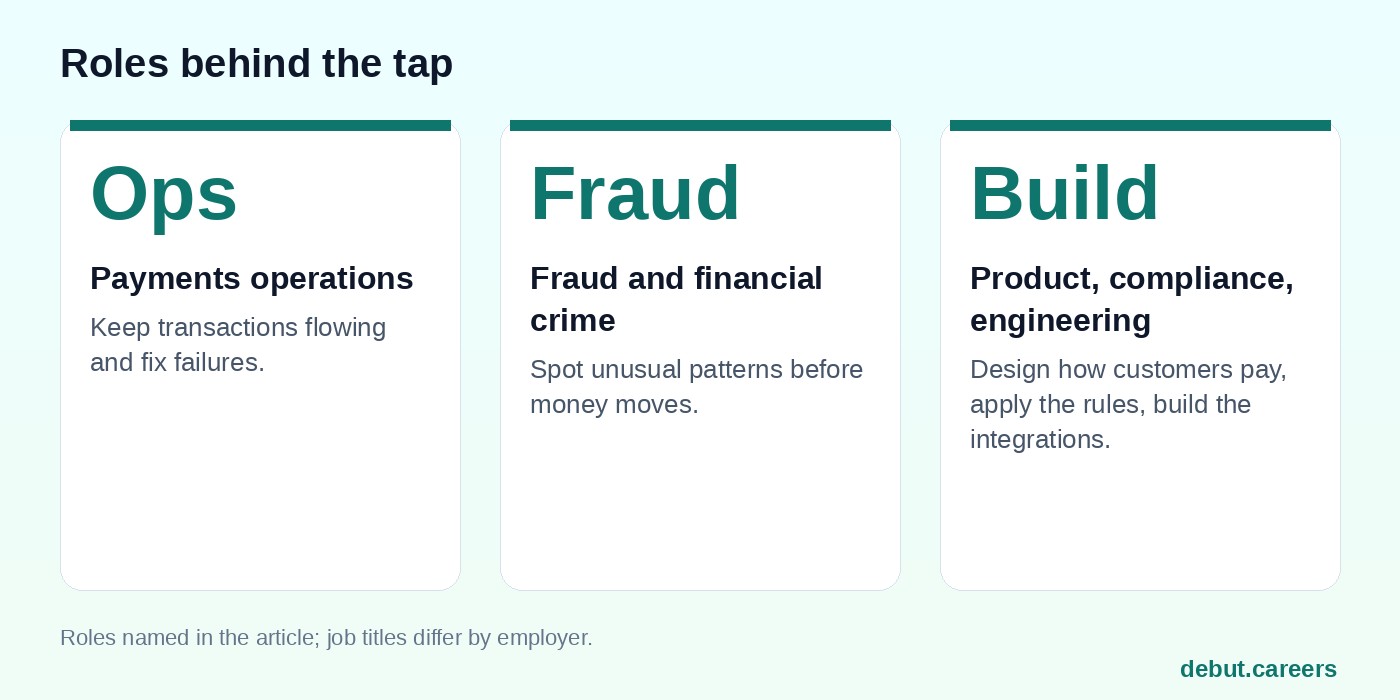
Figure 3. Roles behind the tap.
Graduate routes to check for 2027
Intakes change every year, so confirm dates on each employer’s own careers page. Listings checked on 11 November 2026 on job-board pages (not on each employer’s own site):
-
Visa: Consulting & Analytics graduate programme, London, two years, September 2027 start for people who graduated in 2026 or graduate in summer 2027. On the listing we checked, applications are not open yet (register interest). Visa requires permanent right to work in the UK and does not sponsor this role.
-
Checkout.com: 2027 Technology Graduate Programme (#NextGen), London, for people graduating in summer 2027 or within the last 24 months; payments knowledge is a bonus, not required. Applications closed on 28 October 2026, so watch for the next intake.
-
HSBC: Transaction Banking (Global Payments Solutions) graduate role for July 2027 starters; applications are reviewed on a rolling basis and may close early.
-
Worldpay and Mastercard: no confirmed 2027 intake found; check their careers pages.
Where to Build Your Knowledge
Before applying, it helps to understand how the UK payments system fits together. Faster Payments, Bacs, card schemes, open banking and digital wallets all play different roles, and interviewers like candidates who can explain the basics in plain words.
The trade body for the UK banking and finance industry, UK Finance, publishes research and commentary on payments, fraud trends and how people pay, which is a good place to get familiar with the vocabulary. Reading one or two of its reports before an interview gives you concrete examples to talk about.
It is also worth following how specific companies explain payments to their own customers. Help pages and FAQs show how a business turns complex rules into simple language, and that skill is valued in almost every payments role. To prepare for the application stages, see our guides to psychometric tests and video interviews.
Getting Your Foot in the Door
Payments rewards curiosity. The graduates who do well are usually the ones who ask why a payment failed, why a method was dropped or why a new option suddenly appeared at checkout. Those questions lead straight to the trade-offs between speed, cost, security and regulation that define the industry.
Start with what you already use every day. Look at how your banking app, your phone wallet and your favourite online shops handle payments, note what changes over the next few months, and bring those observations to your applications.
FAQ
Do I need a finance degree to work in payments?
Not always. Engineering roles ask for computing skills, while operations, analytics and product roles accept many degree subjects. Check each job advert.
What is tokenisation in simple terms?
Your card number is replaced by a one-time-use digital token tied to your device, so the merchant never sees the real number.
Can international students apply?
Some employers do not sponsor graduate roles. Visa, for example, states it will not sponsor its Consulting & Analytics programme, so read the eligibility section first.