

Dental hygienists in the UK earn roughly £32,000 to £57,000 a year according to the National Careers Service, and NHS-employed hygienists are paid on Agenda for Change Bands 5 and 6 (Band 7 for senior roles). Private practice pay is not published in any official source, so treat any single private figure with caution. This guide uses the 2026/27 NHS pay scales, the National Careers Service and GDC figures, updated 8 November 2026.
Dental hygienist salary UK: at a glance
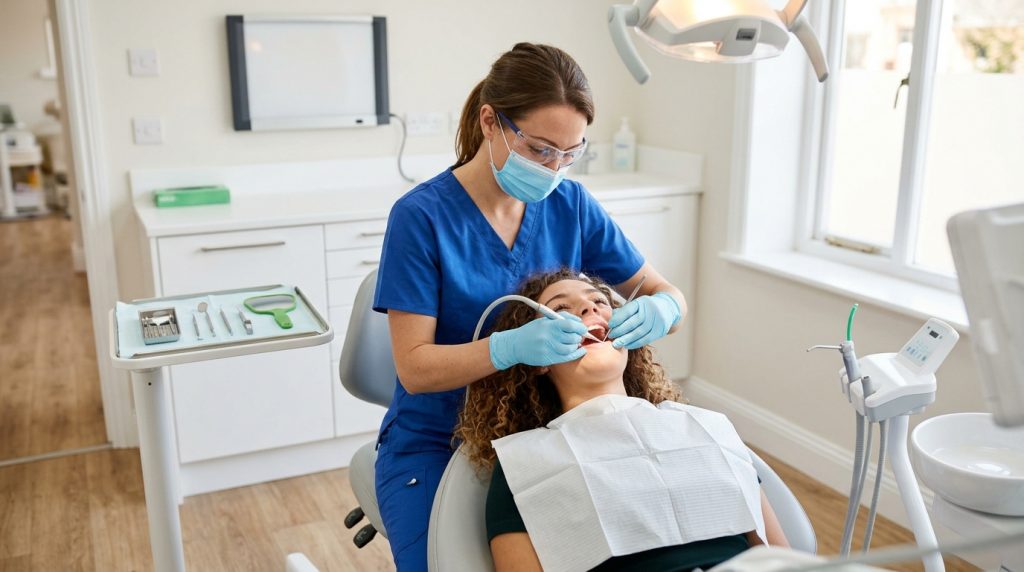
NHS dental hygienist pay bands 2026/27
NHS Employers published the 2026/27 Agenda for Change scales, effective 1 April 2026. NHS Health Careers says a hygienist in an NHS hospital or community clinic might start at Band 5 or 6.
| NHS band (England, 2026/27) | Entry | Intermediate | Top |
|---|---|---|---|
| Band 5 | £32,073 | £34,592 | £39,043 |
| Band 6 | £39,959 | £42,170 | £48,117 |
| Band 7 | £49,387 | £51,932 | £56,515 |
Inner London roles add a high cost area supplement: the NHS Employers page lists inner London starting points of £38,488 (Band 5), £47,951 (Band 6) and £58,133 (Band 7). Source: NHS Employers pay scales 2026/27. Some third-party sites show lower Band 5 figures; they do not match the official scale, so we do not use them.
Private practice and self-employed hygienists
Many hygienists work in dental practices or are self-employed, so pay and hours vary by practice and by how sessions are paid. No official source publishes a private pay figure, so we give none. When you compare an offer, ask whether it is salaried or per session, who pays for indemnity and GDC fees, and how many hours are guaranteed.
How to become a dental hygienist
- Entry requirements: NHS Health Careers lists five GCSEs at grades 4 to 7 plus two or three A levels, or a recognised dental nursing qualification. Degree courses often want a biology A level.
- Choose a GDC-approved course: the British Society of Dental Hygiene and Therapy lists a 2-year Diploma in Dental Hygiene, a 27-month Diploma in Dental Hygiene and Therapy and a 3-year BSc, across 19 UK training schools.
- Register with the GDC before you can practise.
- Apply for NHS or practice roles and check whether you start on Band 5 or 6.
Costs and registration
| Item | Figure | Source |
|---|---|---|
| GDC annual retention fee, dental care professionals, 2026 | £108 | GDC |
| GDC annual retention fee, 2027 | £111 | GDC fees page |
| Study support on some level 5 or 6 courses | At least £5,000 a year, no repayment | NHS Health Careers |
Is dental hygiene a good career for graduates?
It suits graduates who want a clinical role with a defined registration route and a rota of regular hours. Compare it with other healthcare pay on our EMT salary guide, or with non-clinical routes in our flight attendant salary and pilot salary guides. For graduate employer pay, see the Graduate Scheme hub.
Dental hygienist salary FAQ
How much does a dental hygienist earn in the UK?
£32,000 to £57,000 a year per the National Careers Service. NHS pay in 2026/27 runs from £32,073 (Band 5 entry) to £48,117 (Band 6 top) for typical roles.
What NHS band is a dental hygienist?
NHS Health Careers says starting pay might be Band 5 or 6.
How long does it take to qualify?
Two years for the diploma, 27 months for the hygiene and therapy diploma or three years for the BSc, according to BSDHT.
How much is GDC registration?
£108 for dental care professionals in 2026 and £111 in 2027.
Last updated 8 November 2026 from NHS Employers, NHS Health Careers, the National Careers Service, the GDC and BSDHT.